

Ed Weilbacher Reflects On Unexpected Second Career
This month marks the official retirement of Ed Weilbacher as general manager for the Kaskaskia Regional Port District. The Kaskaskia River, Illinois’ second-largest river, arises in east-central Illinois and flows 324 miles to join with the Mississippi River near Chester, Mo.
On January 1, 2026, Kaskaskia Regional Port District Assistant Manager Brent Donovan will officially take over as Weilbacher’s successor.
During Weilbacher’s tenure, the port district and river have seen significant recovery and growth. In 2025, KRPD surpassed 2.5 million tons in transportation, a number it has not seen since 1993.
To mark his retirement and reflect on his career, Weilbacher recently sat down for an interview with The Waterways Journal.
The Waterways Journal: How did you wind up as general manager for the Kaskaskia Regional Port District (KRPD) in 2011?
Ed Weilbacher: The position as general manager was going to be open with the retirement of George Andres at the end of 2011. The chairman,
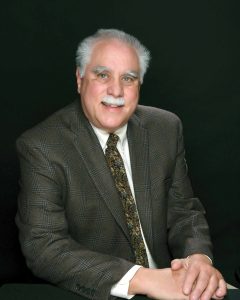
George Obernagel, and vice chairman Terry Liefer led the charge to find a replacement.
I worked for USDA’s NRCS [Natural Resources Conservation Service] as the coordinator for the Southwestern Illinois Resource Conservation and Development (SWI RC&D). I retired in June 2011 with no intention of working another job. At the SWI RC&D, I had worked in the area for 20 years on natural resource projects. I was very active in the region, working to improve the Kaskaskia River in both natural habitats and water quality. I regularly attended the Lower Kaskaskia Stakeholders, Inc. (LKSI) meetings.
In June, George and Terry met with me to discuss the position. I turned down the opportunity two times. Being persistent, they met with me a third time. My wife said I should give it a try. She said, “You could always quit.” That was 14 years ago!
WJ: Who were your most important mentors back then?
EW: I was fortunate to work with George Andres for three months before he left. That was very valuable to get me oriented to the operations of a port district and the history of the terminals.
Besides George Andres, my early mentors included Dennis Wilmsmeyer at America’s Central Port, Bill Pappe at USDOT MarAd, Gateway Directors Branden Crimen and Travis Black and B.J. Murray at the Illinois Department of Transportation. My chairman, George Obernagel, was always a great mentor and advisor.
WJ: What were the main challenges of the early days? How have they changed since then?
EW: The main issue facing the port when I started was the lack of a strong financial portfolio. Mr. Andres worked hard with very little. He put deals into place that would eventually grow the financial position of the port. It was also at a time that tonnage was starting to move upward.
Before I started, the KRPD-owned terminals shipped almost 800,000 tons in 2011. Today we ship, from KRPD-owned terminals, 2,543,000 tons. The first thing I worked on was developing relationships with leaders, elected officials, port tenants and operators. Then I began prioritizing projects and developing budgets to support capacity and future growth at the terminals. Since the port was established in 1965, I needed to understand all legacy agreements and contracts.
The other major challenges in the first several years were the back-to-back floods that caused major delays in shipping. One memorable event was the drought in December, and by June the next year we had one of our highest floods. We went from one of the lowest river levels on the Mississippi to one of the highest flood events in less than six months. Flooding has lessened in recent years, and we were able to begin growing our tonnage. That led to job creation.
WJ: What were some early successes?
EW: The very first project was the need to rebuild the entrance road at KRPD#2. It was never built to withstand the volume of traffic that the terminal was now handling. I had no money to work with. Twelve years earlier, the port attempted to extend a potable water line to the terminal. Due to lack of funding, that project was shelved. The port was also in need of a new office building. We had outgrown our space at the post office.
A board member was aware of a company that wanted to expand at KRPD but never pulled the trigger. He approached them with the opportunity to expand their operations at KRPD#2 and agreed they would bring 16 new jobs to the port. They would also need potable water. These jobs leveraged grant funds from DCEO, EDA and IDOT. As a result, the port was able to package a grant that would fund 100 percent of the new concrete entrance road and extend the potable water line under the Kaskaskia River to the terminal.
The agreement with Gateway FS to expand at KRPD#2 provided the port with the financial capacity not only to purchase a former grocery store and remodel it for the new office for the port, but also to create two additional tenant spaces for lease. This was a win-win-win-win!
With the new Kinder Morgan Slay Joint Venture at Kellogg, we began shipping coal through that terminal in 2012. That was also the year we began shipping scrubber stone to Prairie State Energy Campus, the newest (and last) coal fired power plant built in the country. That first year we shipped 109,000 tons. Today, we ship, on average, 750,000 tons of scrubber stone to the power plant.
When I joined the port, I found that the Kaskaskia Regional Port District was not listed as a port in the Waterborne Statistics by the Army Corps of Engineers. After two years of coordination, we got added to the dataset. Today, we are the 66th largest port by tonnage in the country and the 11th largest inland port by tonnage in the country.
WJ: Which industries offered key support?
EW: Gateway FS at Evansville started to increase their grain shipments and have been strong champions for the river. Prairie State was critical in growing our tonnage. The Material Works (TMW) at KRPD#2 would receive steel coils for processing. Fertilizer at KRPD#2 also more than doubled in 2012. Southern Illinois Transfer increased their efficiency with the movement of tows on the river.
What was once a single commodity river (coal), changed into a diverse commodity mix that will allow the river to be sustainable in cargo shipments well into the future. The U.S. Army Corps of Engineers was also very helpful in meeting the needs of our cargo clients.
LKSI [Lower Kaskaskia Statekholders Inc.], a non-profit organization, was very instrumental in educating the public and elected officials on the value of the river to the residents and the region. They serve as the river’s cheerleader.
WJ: Were there any unexpected factors that worked either for or against the success of the KRPD?
EW: Obviously, the loss of coal shipments in 1999 was a devasting blow to tonnage and corresponding income to the port. Tonnage shipped on the Kaskaskia River in 2000 reached a low of 404,000 tons. There was even a proposal by the Army Corps of Engineers to close the river to barge traffic. That dire warning rallied the community to keep the river open for commerce.
As a result of cargo diversification, we are now at 2,550,000 tons, with the projection to ship 4,250,000 in two years, exceeding the highest year of coal shipment in 1989 at 4,100,000 tons. It is often very difficult to replace lost tonnage.
Most recently, we have been able to capitalize on the growth of tonnage, job creation and grant opportunities to upgrade our aging infrastructure and expand our capacity including by land acquisition. Today, we have $45 million in funded projects. We have completed about $8 million worth of the $45 million.
WJ: How did high-water/low-water events on the Mississippi River affect the district?
EW: The Kaskaskia River is fortunate to have the Jerry F. Costello Lock and Dam as it joins the Mississippi River. That lock and dam placed into service in 1974 maintains a pool elevation at 368.8. This pool is constant, even through droughts. The tows never have to be light loaded due to shallow water.
The largest problem results from flooding caused by the Mississippi River backing up into the Kaskaskia River. Those large floods cause the JFC Lock and Dam to be closed for barge traffic. Often, the floods are not long in duration, and cargo can move again. The Corps of Engineers has just made a major upgrade to the lock arms. The new lock arms allow for the lock to operate at 3-foot higher elevations during floods. This improvement will shorten the duration of any lock closure due to flooding.
WJ: Can you talk specifically about the growth of the steel industry on the Kaskaskia and middle Mississippi?
EW: We are very fortunate to have a locally grown steel processing company located at KRPD#2. They are considered a premier toll processor of steel coils up to 3/8 inches thick. They are an industry leader and innovator in the descaling of steel coils with a process known as EPS. This method of processing does not use harsh acids but rather water and grit. It is a very environmentally friendly processing technology. They have patented the process. The river gives them a competitive advantage in receiving steel coils by water.
The port is partnering with TMW on a new plant that will be built at KRPD#2, and that new line will process coils of steel up to ¾ inches thick and 84 inches wide. TMW is now the largest toll processor in one location in the country. To meet the electrical demand of the plant, our local electric cooperative, Egyptian Electric, was able to get a $1.8 million grant to build a new substation at the port. This new substation will provide power for even more growth at the port.
WJ: How has support from the state fluctuated over the years? Or has it been consistently strong?
EW: Like all other ports in Illinois, we receive no annual appropriation for operations. Port infrastructure funding was made available to ports in Illinois in 2020. This one-time funding opportunity for infrastructure was very helpful to KRPD. We were able to install a new conveyor at KRPD#2 that will increase the fertilizer shipments and allow the tenant to expand their facility by 40 percent. It was a great win-win. In addition, IDOT is assisting with a $10 million upgrade at KRPD#1 with the installation of a second rail loop. This new loop will allow us to ship inbound and outbound products at the same time and increase our total tonnage through this terminal to over 2 million tons.
WJ: Which elected officials have been especially supportive?
EW: The port is blessed with strong support from all levels of government. Our local county boards have assisted KRPD in all aspects of project development. Our state senators and representatives have been great champions for the port. On the federal level, our congressman, Mike Bost, has been instrumental in getting more funding for the lock operations and upgrades at the Jerry F. Costello Lock and Dam. Our senators, Dick Durbin and Tammy Duckworth, were extremely helpful and engaged with us whenever we need them. We couldn’t ask for more. They always step up to the plate when we need them.
————
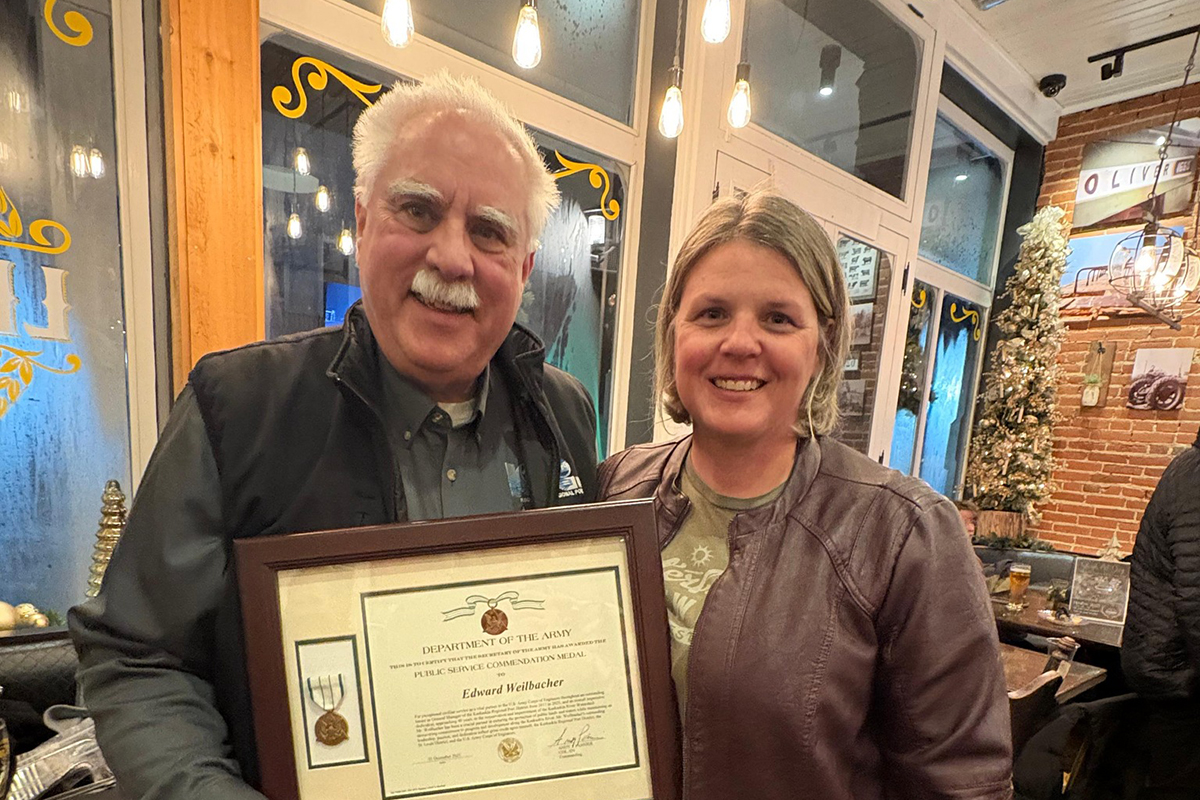
Featured photo caption: Ed Weilbacher, who received a public service award earlier this month from the St. Louis Engineer District, stands with Courtney Wilson, operations manager of Carlyle Lake for the Corps of Engineers. (Photo courtesy of the St. Louis District)