
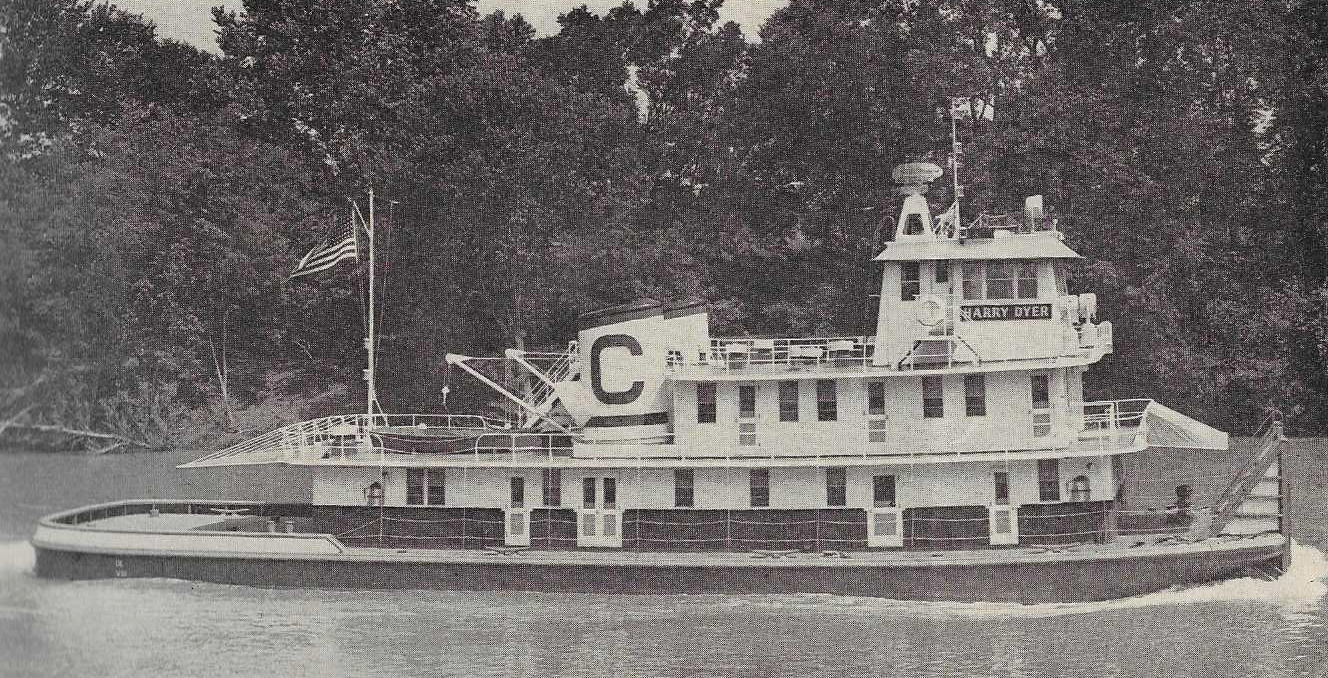
The Harry Dyer Had A Bright Start And Dramatic End
While researching last week’s column, Capt. Jeff Yates sent me some material that brought two other towboats that had been built by the Nashville Bridge Company (NABRICO) to mind. These two boats proved that NABRICO and its customers’ relationships were so close that these two boats were named for members of the family that owned the shipyard.
Capt. Joseph Chotin had dealt with NABRICO dating back to 1923, and the construction of the steam sternwheel J.N. Pharr (The Waterways Journal June 27, 2022). NABRICO would build a replacement for that vessel, the steam sternwheel Jos. Chotin, in 1936, and then have the diesel prop Irene Chotin built there in 1941. Chotin would continue to turn to NABRICO for most of its towboats for years to come.
When NABRICO shifted production from war needs back to private vessels in 1946, the outward design that would define a NABRICO-built towboat for decades was well established. The boat hulls had graceful sheer and camber, and the cabins followed suit. The stacks became slightly streamlined. The distinctive visor around the top of the pilothouse had a rakish angle, and awnings were at both bow and stern of the main cabin.
In 1948, Chotin took delivery of the 2,500 hp. Scott Chotin, built by NABRICO. In the May 28, 1949, issue of The Waterways Journal, a small story on page nine was headlined “Newest Chotin Towboat Is Completed.” It said that a near duplicate of the Scott Chotin was to be christened at Nashville on May 31.
The June 11, 1949, issue of the WJ carried a detailed description of this newest vessel for Chotin. The piece stated that the Scott Chotin, delivered the previous year, had, in a short time, “proved to be such a highly successful towboat that the owners ordered the new boat to be a duplicate in nearly every respect.” Since NABRICO had built most of the boats that Chotin owned and “had offered so much to the pioneering development and actual construction of inland river equipment,” Capt. Joseph and son Capt. Scott Chotin had named the new craft Harry Dyer after the NABRICO president.
The Harry Dyer was of all welded steel construction with a hull that was 116 by 30 feet. The 2,500 hp. was provided by a pair of GM (Cleveland) 16—278A diesels and Falk reduction gears. The hull was molded “on extremely fine lines,” and the after portion was “well rounded and shaped to provide a maximum streamlined flow of water to each propeller operating in a shallow tunnel and a NABRICO semi-nozzle.” This “semi-nozzle” was essentially a half kort nozzle.
The pilothouse windows “sloped inward from bottom to top” to reduce glare, and the three large front windows could be raised and lowered by a hydraulic system. The boat was equipped with the latest navigational aids, including an RCA radar. The gauges and dials on the console would glow in the dark under a black light. It was expected that the Harry Dyer would “join the Chotin fleet to establish new standards of efficient towing.”
Following the christening and an open house attended by several hundred people, the Harry Dyer was delivered to Paducah, Ky., where it was officially accepted by the owners. The listed owning firm was J. and S., Inc., New Orleans. The initial crew was composed of Capt. Scott Chotin, master; Capt. Roy Davault, pilot; Charles Bradley and Milton Medley, engineers; Tony Bennedetto, mate and Soloman Wilson in the galley. It entered service towing a unit tow of tank barges.
The listing for the Harry Dyer in the 1957 edition of the Inland River Record indicates that the horsepower rating had been increased to 3,200. The boat continued in service for Chotin until it was sold in April 1969 to Oil Transport Company, Inc., (OTC) New Orleans. OTC, known as “The Bayou Fleet,” renamed the boat Bayou Couba, following their tradition of naming their vessels after bayous. It then was seen all over the inland river system towing unit asphalt tows.
In 1979, the boat was extensively rebuilt and repowered with a pair of Alco 12-251B engines totaling 3,800 hp. At 6:30 p.m. on November 6, 1982, the Bayou Couba was downbound above Golconda, Ill., with an empty asphalt tow, enroute from Cincinnati to New Orleans, when fire broke out in the engineroom. The boat soon lost all power and was drifting. Yates, representing The Waterways Journal, headed to the scene from Paducah as soon as he heard about the incident, wrote a detailed story concerning it in the November 13, 1982, issue and captured many dramatic photos, many also used in the local newspaper.
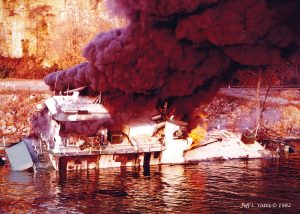
According to Yates, the Walter Hagestad of Canal Barge Company was the first vessel to arrive and assist, nudging the burning boat and tow into the Illinois shore near old lock 51 at Golconda. The Betty June Walker of Walker Towing Corporation and the Jennie Dehmer of Magnolia Marine Transport tied their respective tows off to the bank and soon arrived to assist. Though the fire appeared to be under control before midnight, it continued to flare back up, and, at 5 a.m. on November 7, the decision was made to let the fire burn out.
The burning boat partially sank and was beached on the shore. The fire continued in a spectacular fashion until it eventually did burn out. Fortunately, Yates reported, there was only one minor injury to a Bayou Couba crew member. The vessel was a total loss and was raised and scrapped.