
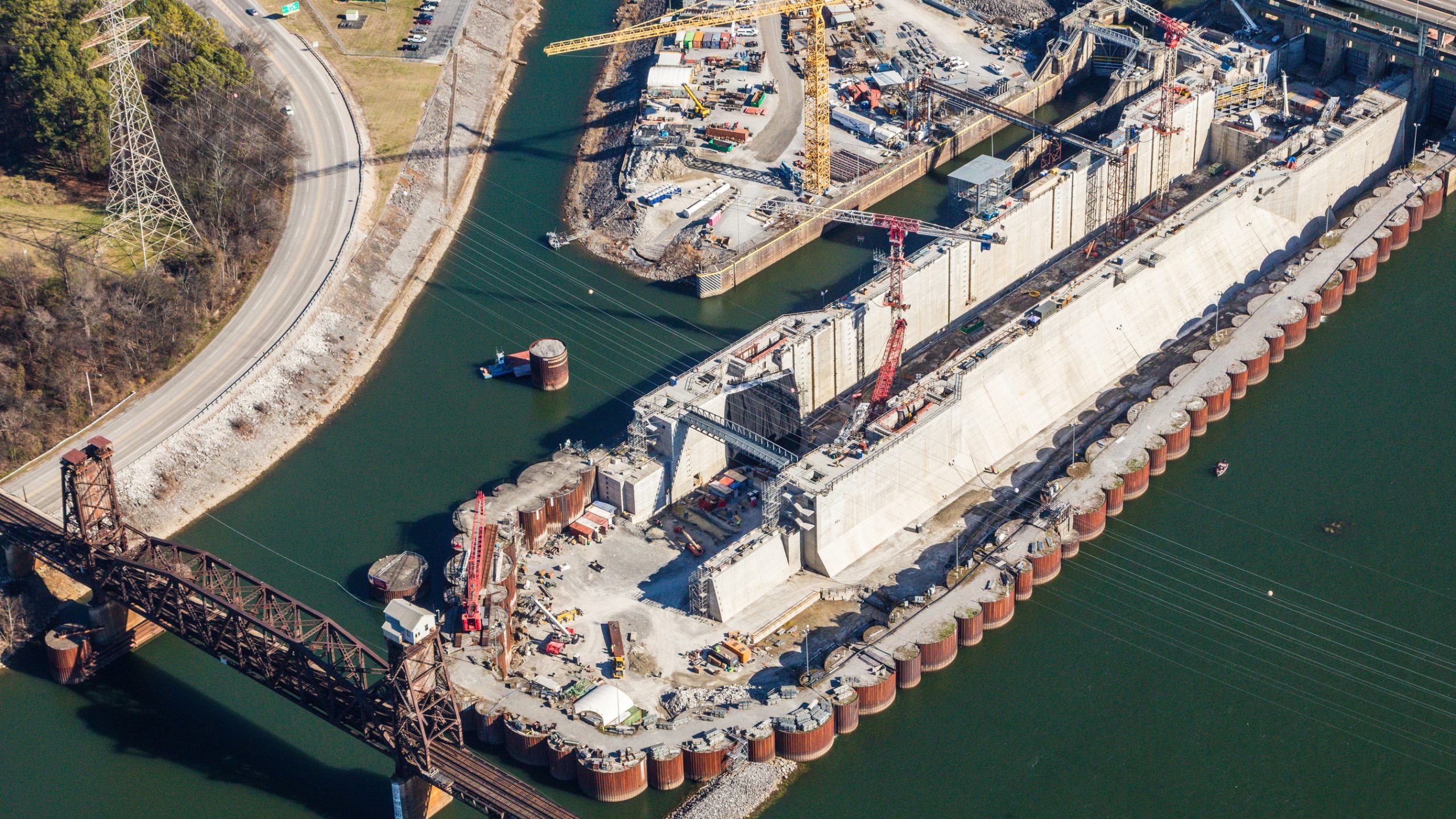
Regional Roundup: Tennessee River – TRVA Prioritizes Lock Project Funding
With new cost estimates out for the Kentucky and Chickamauga lock projects, efficient funding for them is a key priority of the Tennessee River Valley Association (TRVA).
In a June 16 email to membership, Cline Jones, executive director of both the TRVA and the Tennessee-Cumberland Waterways

Council, said that he had just learned that the Corps of Engineers’ Post-Authorization Change Reports (PACR) for the Kentucky Lock Additon Project and Chickamauga Lock Replacement Project had been made public and that both will need millions of dollars more for completion.
The Kentucky Lock project, at Tennessee River mile 22.4, is authorized for $1,446,219,000. It will require reauthorization to $2,741,549,000, at the Fiscal Year 2026 price level. That’s an increase of just over $1.295 billion. The project is listed as 60 percent physically complete.
The Corps has 96 percent confidence in the certified cost estimate, according to a June 11 memorandum from Maj. Gen. Jason E. Kelly, deputy commanding general for civil and emergency operations, to the assistant secretary of the Army for civil works.
The Chickamauga project, at Tennessee River mile 471, is currently authorized for $1,018,620,000 and will require reauthorization to $1,566,787,000 at the FY 2026 price level, an increase of more than $548 million, according to a second memorandum from Kelly, also dated June 11. The project was estimated at 80 percent physically complete and 38 percent fiscally complete.
The two memoranda from Kelly were enclosed with the PACR for transmission to Congress as a basis for increasing the authorized project costs.
Kelly attributed the increased cost of the Chickamauga project to changes in market conditions; limited competition; contingency and contract modifications; and assumptions.
He attributed the increase in the costs to the Kentucky Lock project to the need for contingency funds; design and construction methodology changes and cost increases resulting from design maturity; changes in construction schedule and acquisition strategy that exceeded initial assumptions and contingencies; escalation required as a result of “the extended duration of the project”; and market conditions, including increases in contractor overhead, electrical and mechanical subcontractor costs and direct labor rates.
The reauthorization of these two projects in the Water Resources Development Act of 2026 and funding at sufficient levels in future appropriations is extremely important to TRVA and the region, Jones said.
Jones voiced his concern over the ballooning prices, noting that the roughly $1.8 billion increase in total for both projects is considerably more than the initial combined cost estimates originally authorized for their construction. The Kentucky project was first authorized in 1996. The Chickamauga project was first authorized in 2003.
Additionally, he said TRVA members are concerned about the reportedly lengthened construction timeline for the Kentucky Lock project.
“We’re understanding that Chickamauga is still on target for a ‘28 opening, but we’re hearing that Kentucky could be more than a decade (in additional construction time),” he said.
The earliest operational date for the new chamber at Kentucky was previously scheduled for July 2029, according to a presentation at the Inland Waterways Users Board’s last meeting, in December 2024. However, that briefing included a warning that maintaining that date could be a challenge as the Corps moved away from an integrated design and construction acquisition strategy and dealt with funding uncertainties.
Inland Waterways Board Repopulation
Jones said he and others, including some Congressional staff members, have not received detailed information from the Corps of Engineers about factors contributing to the cost increases. Jones said it is TRVA’s understanding that, going forward, detailed communication between the Corps and industry leaders would come through traditional channels, including the Inland Waterways Users Board (IWUB). That board was paused in early March 2025 when the Department of Defense suspended all federal advisory committees for a 45-day review to determine how they align with President Donald Trump’s administrative priorities. President Joe Biden also paused the board, from February 2021 to early 2022, when his administration took over.
While the IWUB was reconstituted and reactivated in May 2025, the Department of the Army announced it would restart it with all new member nominations. Three notices seeking member nominations were published in the Federal Register, with the most recent taking place in December 2025.
Both projects have experienced major changes over the past year. The Pittsburgh Engineer District took over management of the Kentucky Lock project from the Nashville District in August 2025, with the Corps noting the Pittsburgh District’s recent experience in completing the John P. Murtha Locks and Dam Project and its proximity to the Inland Navigation Design Center. On May 8, 2026, the Nashville Engineer District terminated a $309-million contract with the Chickamauga project’s prime contractor, Shimmick Construction Company, Inc., citing “failure to prosecute the work with diligence, maintain project schedule, progress critical work, correct quality deficiencies and manage project controls,” according to a Nashville District news release. Shimmick disputes the claims, saying they were “not supported by facts.” The company has announced it is appealing the decision and plans to seek compensation for work-related costs.
Jones said that repopulating the IWUB is critical to industry receiving regular updates about these projects. The TRVA would like to see a representative from the region to serve on the board, he said, noting that a representative from Parker Towing, based on Tuscaloosa, Ala., was among the nominees.
Other Construction Needs
Jones said TRVA also remains concerned about the backlog of projects that Congress has authorized but that the Corps of Engineers has yet to construct.
The 2025 American Society of Civil Engineers Infrastructure Report Card, released every four years, noted that the river infrastructure construction and major rehabilitation backlog had risen to $7.5 billion.
With projects like the Kentucky Lock chamber addition estimated to take more than three decades and Olmsted Lock and Dam, Ohio River mile 964.4, previously taking 30 years, from its authorization in 1988 to its completion in 2018, Jones said projects are now taking more time, which costs more, making it difficult, if not impossible, to cut into that backlog.
Meanwhile, he said, while it is necessary for funding to continue to flow to projects already under construction, other projects are lingering. He repeated a frequently used statistic from Waterways Council, Inc., that 80 percent of the locks and dams on the nation’s navigable rivers are past their 50-year design lives already.
The difficulties of aging infrastructure became apparent in a sudden and visible way along the Tennessee River, Tennessee-Tombigbee Waterway and Black Warrior-Tombigbee Waterway with emergency failures at three lock projects – Holt, Demopolis and Wilson – in 2024 that led to extended lock closures.
“These failures are canaries in the coal mine,” Jones said, suggesting they are an early warning of what could be even greater problems if these structures are not repaired or replaced.
While each of the lock chambers reopened within months with interim repairs completed, permanent repairs to “critical stability issues with the monolith structure,” including cracks and leaks, have not yet been completed at Holt Locks and Dam.
The Mobile Engineer District began the first phase of a multi-phase permanent restoration to the structure at Holt, Black Warrior River mile 347, in January. It involves installing rows of large post-tensioned anchors. That work was to take place above the water level, allowing navigation traffic to pass through the lock on a pre-arranged schedule. However, the district said in an April 28 news release that future phases of the restoration will involve more intensive work, including installing additional rows of post-tensioned anchors and placing mass concrete to secure the lock’s foundation and walls permanently. The Mobile District has separated the upcoming work into two closures, scheduled for this summer and fall. Jones said industry is working closely with the Mobile District to schedule the timing of those repairs so that the work can be completed quickly while also minimizing the impact to commerce.
Another project on Jones’ mind is the need for a permanent replacement for the floating upstream guidewall at the main chamber of Wilson Locks and Dam, Tennessee River mile 259.4, in Florence, Ala. The guidewall sank in the remnants of a hurricane in August 2021. As a result, tows were encountering delays averaging 13 to 15 hours by fall 2023.
In July 2025, the Tennessee Valley Authority (TVA) installed a temporary replacement wall made of three interlocking ocean-going barges with spuds sunken into the riverbottom. The barges are expected to serve for five to 10 years until a permanent floating wall is built. Jones said that while the temporary solution is working well, a permanent one is still necessary and should be pursued quickly, given the time it takes to fund, schedule and complete construction.
Economic, National Security
Jones also noted the importance of the locks and dams to national security and the national economy. As an example, he pointed to advanced manufacturer Hadrian, which held a ribbon-cutting ceremony at its new plant near Cherokee, Ala., in March. The company intends to manufacture submarine components, which will be moved by barge on the river system to Mobile for final assembly. Jones said the company is building its docks now.
“We’re excited about that, and we hope there will be production across northern Alabama that will help support those efforts at Hadrian and the Martin/Cherokee area,” he said.
Jones also noted that test facilities at the Marshall Space Flight Center along the Tennessee River in Huntsville, Ala., are important for the nation’s plans to return humans to the moon and on to Mars. Components of those rockets move along the river in NASA’s Pegasus barge.
Meanwhile, United Launch Alliance is ramping up production of its new Vulcan rocket, used to deliver satellites and launch NASA science payloads. The rocket is built in Decatur, Ala., and it is transported on the custom-built roll-on/roll off vessels the RocketShip and the SpaceShip, which transport them down the Tennessee and Mississippi rivers to the Gulf for delivery to launch sites at Cape Canaveral, Fla., and Vandenberg Space Force Base in California.
Jones said it is also important to remember other river infrastructure projects, such as enlarging a lock chamber at the Montgomery Locks and Dam on the Upper Ohio in Monaca, Penn., and the construction of a 1,200-foot chamber to replace a 600-foot chamber at Upper Mississippi Lock and Dam 25 near Winfield, Mo. Although they are not within the immediate region, “It’s all tied together,” Jones said. “It’s interdependent.”
He concluded, “I can’t think of an unimportant lock anywhere.”