
The First Towboat For Union Barge Line After WWII
From the beginning of World War II, the inland shipyards of the United States had been almost totally committed to building vessels for the war effort. Few commercial towboats and barges were turned out at all during those years, and older steam and diesel boats, some dating back to the turn of the century, had been kept in service out of necessity.
Germany surrendered to the Allies in May 1945, but the fight with Japan in the Pacific continued and would not end until September. Even before the complete cessation of hostilities, there was a slight turn toward normalcy. The June 23, 1945, issue of The Waterways Journal carried a story saying that 16 river pilots serving as Coast Guard officers would be placed on inactive duty status as of July 1. These were part of the famed “Catfish Navy” that piloted vessels built at inland yards to New Orleans.
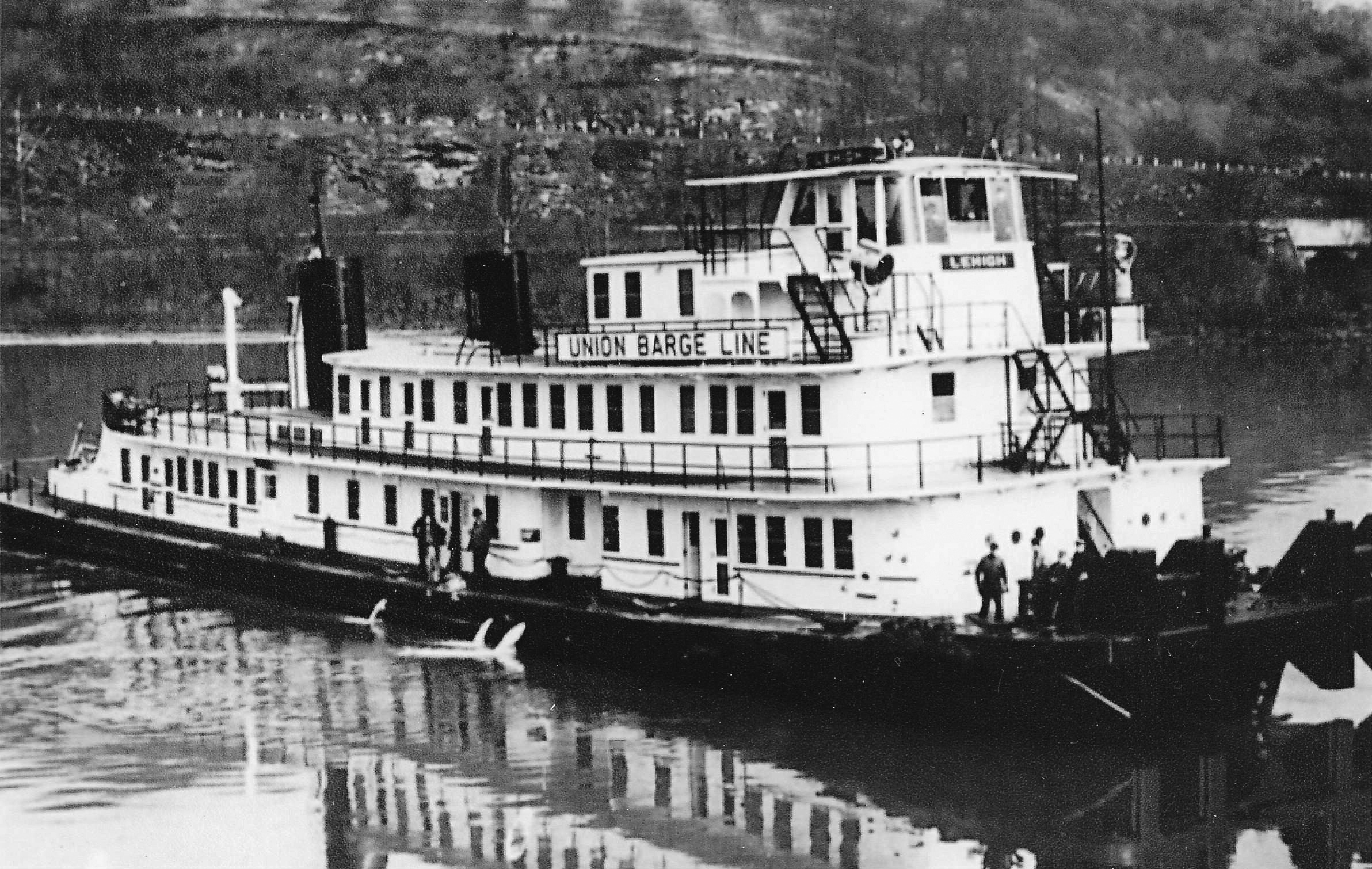
The editorial noted, “Kansas is now harvesting the largest wheat crop in the state’s history,” and it came at a time of a severe barge shortage. “More barges and towboats will be needed after the war as well as now.” Plans for some of these had been ongoing for some time as the Pittsburgh news column said that the Dravo Corporation, Neville Island, Pa., shipyard had laid the keel for the first of two large towboats for Union Barge Line (UBL).
The 1,300 hp. Wm. Penn, built by Dravo in 1940, had been the last new boat for UBL, and the two boats to be built for them in 1945 would be the same 176-foot by 36-foot hull size. The cabin and pilothouse would be slightly more streamlined. The main engines would be National Superior 14.5 inch bore by 20-inch stroke, the same as the Penn, but these engines would be “supercharged” and provide a total of 2,000 hp. at 275 rpm. The thrust would be increased with Kort nozzles, and the large steering rudders would extend 12 inches past the stern transom.
The first boat was to be named Lehigh, and the second would be named Cornell. These boats were very impressive in appearance. They had a full main cabin on the lower deck as well as a very long second cabin above. A smaller cabin was located behind the pilothouse, and two large stacks were on the roof behind the second cabin.
The Lehigh entered service at a time when the UBL fleet still had five active steam sternwheel towboats, one of which was the wooden hull Reliance, dating to 1916. They would soon be sold off as the fleet was populated with more powerful vessels. In 1961, the Lehigh was sold to the Sioux City and New Orleans Barge Line (SCNO) and renamed Jefferson City. In 1962, the boat was extensively rebuilt and repowered with Fairbanks-Morse OP engines of 4,000 hp. At this time, the upper cabin was shortened, and the stacks were moved forward.
After more than a decade of service to SCNO, the Jefferson City was taken to Lemont Shipbuilding and Repair Company, Lemont, Ill. The January 27, 1973, issue of the WJ carried a lengthy piece on the shipyard and the Jefferson City project authored by Don Grot, editorial assistant for the magazine. He described the work as “the complete rejuvenation of the vessel” that was “a blending of designs by Breit Engineering Inc., General Electric and Lemont Ship.”
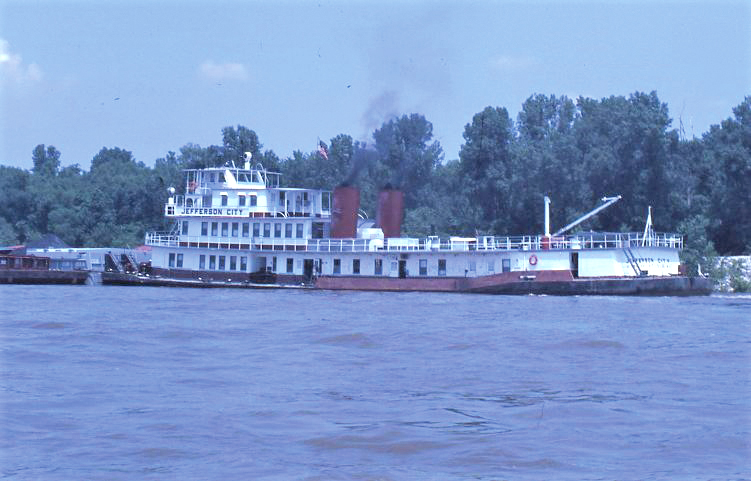
The original stern of the 28-year-old vessel was removed and replaced by a new prefabricated stern that had deeper tunnels and an additional 6 feet of length, making the boat 182.5 feet long. The new tunnels could accommodate propellers that were 111 inches in diameter with 118 inches of pitch. It was repowered with the first pair of General Electric diesel engines installed in a towboat. The GE 7FDM-16 turbocharged engines were coupled to Lufkin 5.225:1 gears and produced 6,200 hp. The rudders and Kort nozzles of the new stern were filled with polyurethane foam for added buoyancy.
It is somewhat ironic that this work was done to a boat originally built by Dravo, the company that pioneered such stern replacement to existing vessels. In fall 1941, the stern of the Mississippi Valley Barge Line (Valley Line) steamer Ohio was replaced, and, following the war, the other three Valley Line “state boats” were similarly rebuilt. In 1948, the diesel towboats Ashland, Paul Blazer and Tri-State of Ashland Oil & Refining had new Dravo Kort nozzle sterns installed.
The Don Grot article pointed out that there was “a favorable cost factor involved in conversion rather than new construction.” The Jefferson City, now with three times the power it had possessed when new in 1945, was utilized on 20 to 30 barge tows between St. Louis and New Orleans. In 1988, it was sold to American Boat Company, Pekin, Ill., and renamed Rolling Thunder. On July 21, 1988, it burned near Heloise, Tenn., on the Lower Miss and was judged to be a total loss.
Featured photo caption: Lehigh new at Dravo in 1945. (Photo from the Capt. Bill Judd collection)