

A Radically Different Towboat
The last column examined a “radically different” style of barge from 1930. This column will look at a “radically different” towboat that was built in 1953.
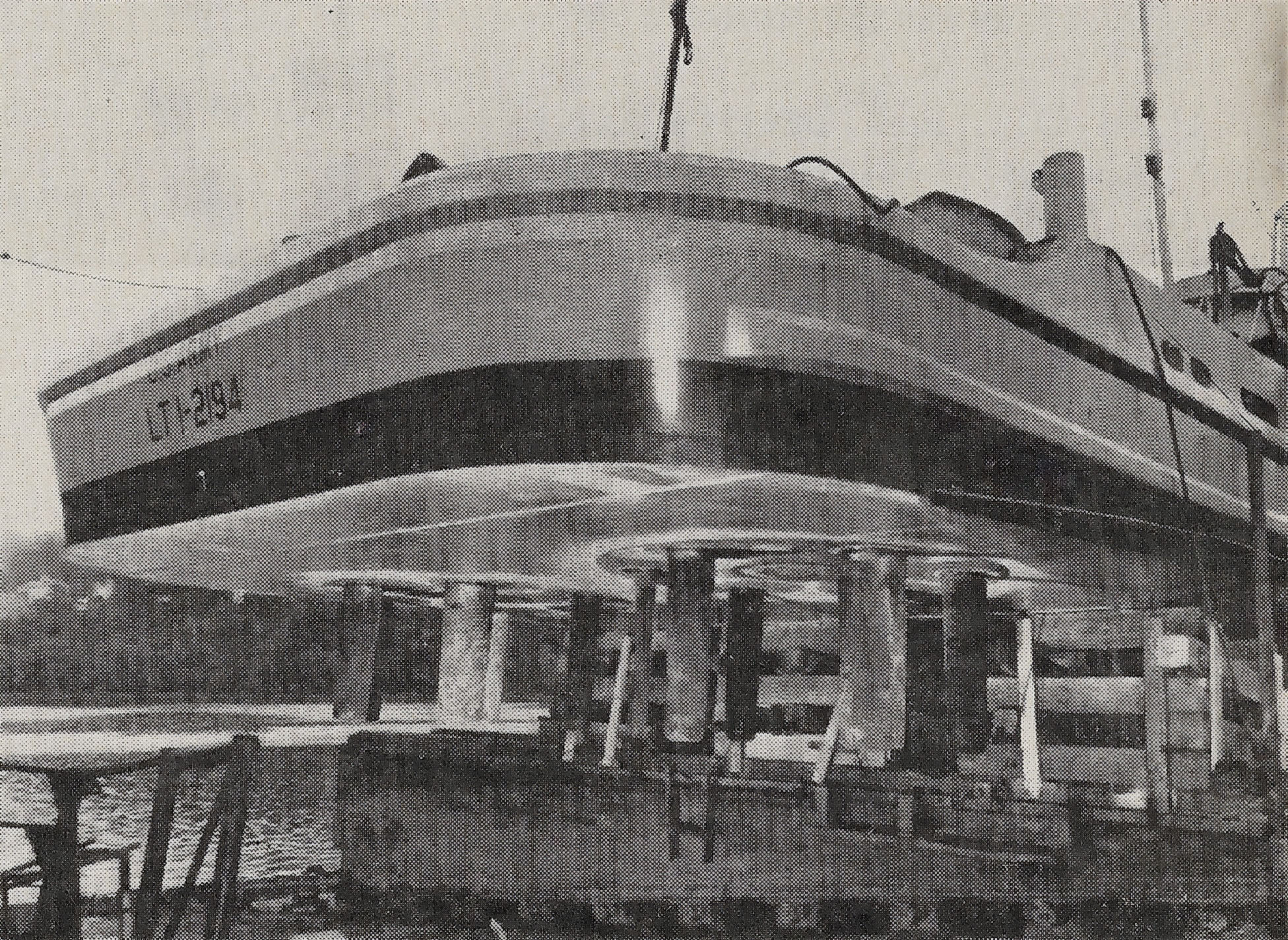
The December 12, 1953, issue of The Waterways Journal carried a feature story about a “unique rudderless towboat” that was further described as “revolutionary.” In addition to being rudderless, it also did not have traditional propellers. What drove the craft was “sinusoidal vertical-axis propellers,” which were made up of 4.5-foot-long blades with controllable pitch, arranged in groups of six that extended down from 11-foot-diameter rotors. Rather than a name, the boat carried the designation for “Large Towboat Inland Waterways” followed by a number, LTI-2194.
The vessel was built for the U.S. Army Transportation Research and Development Command, which had developed the preliminary designs. The final engineering and construction of the craft was done by Dravo Corporation at Neville Island, Pa. The boat was of all-steel construction with a hull that was 150 by 32 feet. Photos would indicate that the hull favored that of the “porthole” style craft built by Dravo in the 1940s, with some quarters located partially below the waterline. The boat had quarters for a crew of 10, and the cabins that extended above the raised hull sides had the look of those found on open-water tugs more so than those of traditional river towboats, featuring watertight doors and portholes.
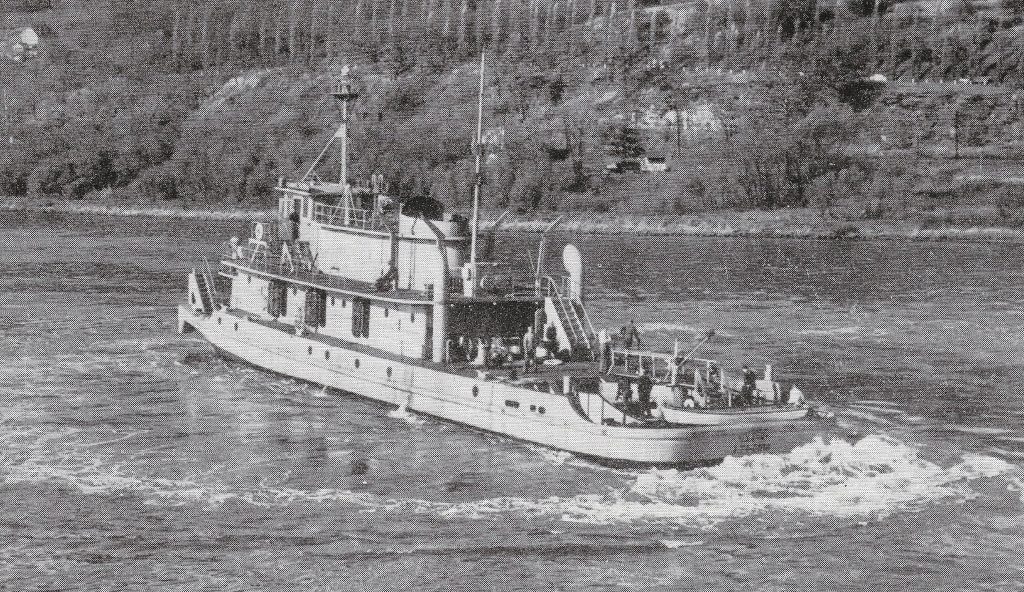
The LTI-2194 was powered by a pair of Cooper-Bessemer 12-cylinder turbocharged diesel engines rated at 1,000 hp. each. The engines turned a maximum top speed of 900 rpm., transitioning through “double-reduction gears” to the rotors, which had a top speed of 76 rpm. The vessel had pilothouse control like most river towboats of the day, with air controls to the engines. Rather than steering levers, there were two steering wheels stacked one atop the other to control direction.
A demonstration of the LTI-2194 was staged at Neville Island on December 6, 1953, and indicated exceptional maneuverability while delivering thrust in any direction. The December 26, 1953, WJ reprinted an article by Capt. Frederick Way Jr. that had appeared in the Sewickley (Pa.) Herald. Way, who had been aboard the LTI-2194 for the trials, began by saying, “I wouldn’t have believed it if I hadn’t seen it.” He noted that the boat maneuvered in such a way that the “engines are not reversed, and neither are the discs; the reversing operation simply comes about by a change of blade position. It isn’t reasonable, but it is so.”
Capt. Way concluded his article by detailing some river “firsts” that he had witnessed and stated that some rivermen aboard for the trials “wondered if the LTI-2194 wasn’t the vanguard of a new era. May well be.” He had earlier stated that the boat was expected to remain at Dravo for a time until being tried in actual service. J. Mack Gamble mentioned in the Upper Ohio News column of the February 13, 1954, WJ that the LTI-2194 was due to enter service that week, operated by the Mississippi Valley Barge Line (Valley Line), and he noted in the same column in the February 27 issue that the boat was downbound with a Valley Line tow and Capt. Norman Hillman in charge.
Capt. Hillman briefly mentions this in his autobiography, “One Man and the Mighty Mississippi.” He spoke of how “It took some experimenting and practice to handle the boat without getting into trouble,” and that “The propulsion units did not prove to work well.” The Upper Ohio News in the June 26 issue of the WJ said that the LTI-2194 was due to lay up at Dravo. It was later taken in tow by a Valley Line boat, delivered to St. Louis and may have been used on the Illinois River briefly. After a lengthy period of inactivity, it was sold in 1961 to D.D. Parker and was extensively rebuilt at the Parker Bros. Shipyard, Houston, Texas.
The stern was redesigned for conventional shafts and propellers, and it was repowered with Fairbanks-Morse OP diesels totaling 3,000 hp. In 1962, it was sold to Sioux City and New Orleans Barge Lines, Houston, and renamed St. Joseph. This company operated the boat on the Mississippi River system, including forays on the Missouri River, until it was chartered to the Norfolk & Western Railway in 1969. Extensive alterations were made, including raising the pilothouse. It then towed the rail transfer barge Manitowoc (of which Capt. Cecil Duncan and I have intimate knowledge) between Detroit, Mich., and Windsor, Ontario.
Renamed R.G. Cassidy in 1970 and later purchased by the N&W, it was in this trade until the ferry service ended in 1994. In 1996, it was sold to Gravel & Lake Services of Thunder Bay, Ontario, and renamed French River. In 1998, it was sold to an owner in the Caribbean and was sent to the Turks & Caicos Islands and renamed Miss Hillary under the Panamanian flag.
The LTI-2194 was certainly not the “vanguard of a new era” as wondered by Capt. Fred Way in 1953, but it eventually did serve a useful purpose over the years.
Featured photo caption: The stern showing the vertical axis blades that propelled the LTI-2194 from the December 12, 1953 WJ. (Photo from the author’s collection)