

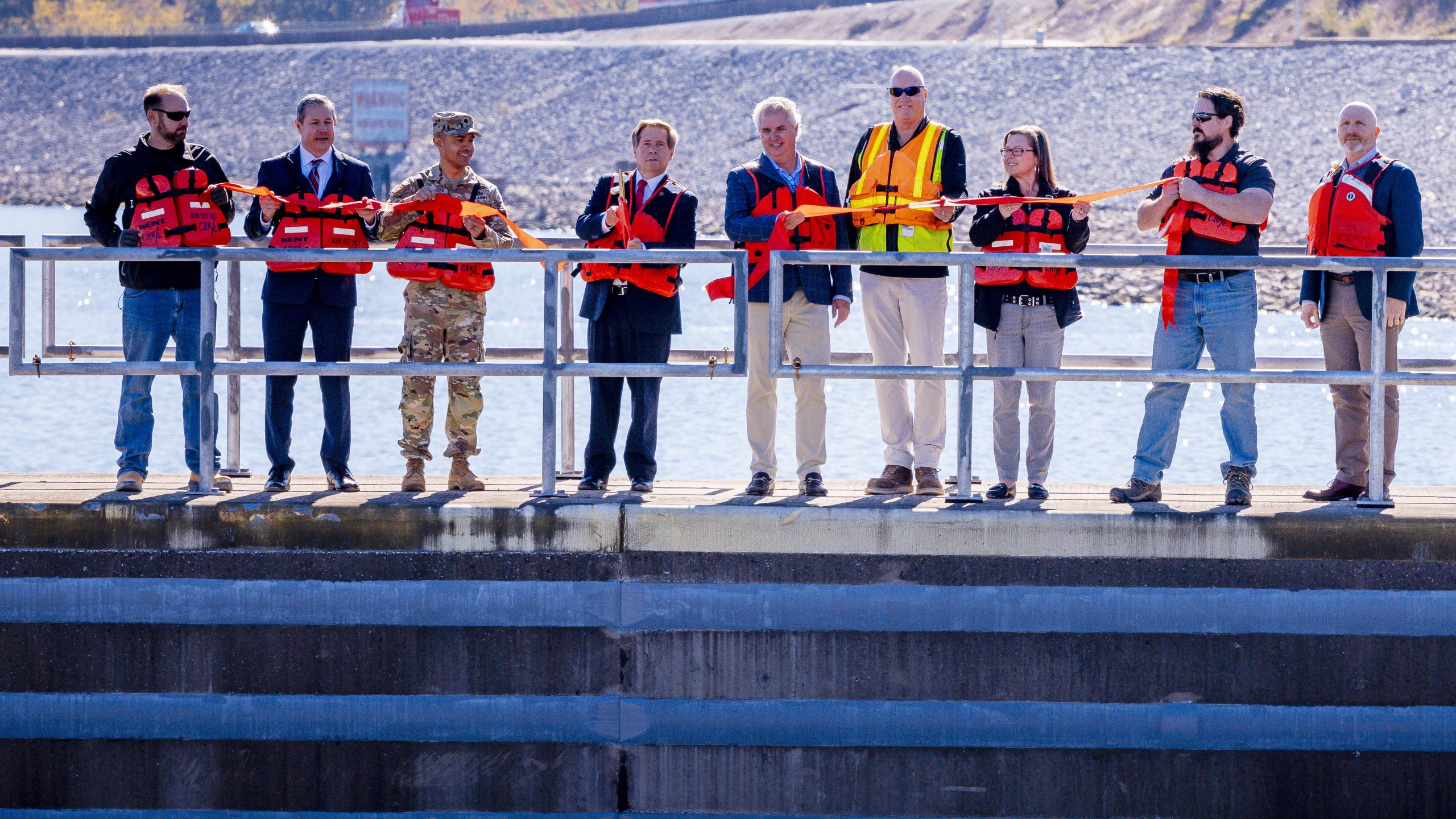
Ribbon-Cutting Marks Chickamauga Lock Project Milestone
The Nashville Engineer District’s ribbon-cutting ceremony November 16 marked completion of the upstream approach wall contract at the Chickamauga Lock Replacement Project, helping to advance the project toward its conclusion.
Project Details
C.J. Mahan Construction Company was the contractor for the project at Tennessee River mile 471 in Chattanooga, Tenn. The upstream approach wall serves as a guide for steering commercial barges and recreational boats safely into the lock chamber.
The lock replacement project will replace the current 1940s-era lock, measuring 60 feet wide by 360 feet long, with a lock 110 feet wide by 600 feet long. The replacement is necessary because of concrete in the existing lock experiencing an alkali-aggregate reaction, sometimes called concrete growth. The chemical reaction between cement and aggregate has caused the concrete to expand, threatening the lock’s structural integrity. The lock replacement project was authorized in 2003.
Constructing the deep-water upstream approach wall demanded intricate marine engineering under challenging river conditions, the Nashville District said in a news release. Crews anchored the foundation by drilling 14 eight-foot-diameter shafts through steel casings into bedrock up to 135 feet beneath the surface. Ready-mix concrete trucks staged on floating barges then placed thousands of cubic yards of underwater tremie concrete to secure the deep-water piers.
Setting the eight 420-ton pre-cast concrete beams for the superstructure required two heavy-lift derrick crane barges operating in tandem to hoist and position, each measuring 120 feet in length. Commercial divers battled currents while guiding each nearly million-pound beam onto submerged bearing pads with pinpoint precision before crews bolted the assembly into a unified, impact-resistant guide wall.
The completed structure is supported across four intermediate piers and two nose piers. The completed structure is designed to provide a continuous navigational guide along both sides of the channel.
Ceremony Remarks
U.S. Rep. Chuck Fleishmann of Tennessee’s Third Congressional District; Lt. Col. Guillermo Guandique, Nashville District Commander; and Doug McCrae, managing partner of C.J. Mahan Construction Company, delivered remarks at the ceremony before joining regional stakeholders on top of the approach wall to cut the ribbon.
“This is a proud day for the entire project delivery team,” Guandique said. “Completing this contract represents the professionalism, the persistence and close interagency partnership required to advance an undertaking of this scale and complexity. More than anything, it reflects our unwavering commitment to delivering a safe, resilient, high quality infrastructure that underpins regional commerce, strengthens the national supply chain and protects the economic vitality of the Tennessee River Valley.”
He also called the Chickmauga Replacement Project a vital, generational investment in the nation’s inland waterways.
“Milestones like today’s matter because each one brings us closer to delivering a fully modernized lock, ensuring the long-term reliability and safety for commercial mariners and recreating public.”
Guandique commended C.J. Mahan, project subcontractors, commercial dive teams, crane operators and craft labor, along with the Nashville District’s engineers, project managers, safety professionals and quality assurance personnel for their work.
According to McCrae, Corps of Engineers gave the contractor three mandates: build a safe, high-quality project; deliver it on time; and complete it within budget.
“On this job, on the upstream approach wall, I believe we’ve delivered on all three requests,” McCrae said. “One in particular, though, I would like to highlight, and that’s our safety record.”
From late 2021 through when work was substantially complete this year in August and on until earlier this month when the job was finished, crews logged more than 303,000 labor hours over 1,856 days without a lost-time injury.
“This success is due to a workforce that cares and looks out for each other, and most importantly takes the time to correct job-site hazards, and as our safety folks like to remind me, Doug, these things don’t happen by accident,” McCrae said.
He also praised the relationship between C.J. Mahan and the Corps of engineers, saying he valued the Corps’ support and partnership and looks forward to it as C.J. Mahan “completes the remainder of this wonderful project.”
Fleischmann, who chairs the House Energy and Water Appropriations Subcommittee, praised the close partnership among the U.S. Army Corps of Engineers and the Tennessee Valley Authority in keeping the existing navigational lock functional, noting that there are more than 300 monitors on it “so that river traffic can go back and forth, whether it’s grain, chemicals or critical minerals, whatever we need.”
Additionally, he commended having a “competent, hardworking, capable contractor in C.J. Mahan.”
Once complete, the new lock will allow nine jumbo barges to transit the chamber at one time instead of one at a time.
“I look forward to being back with you all when we cut the final ribbon, and we bring nine barges at one time, as opposed to one through the existing lock,” Fleischmann said. “This will be an American success story. This happens when we work together, as Republicans and Democrats, as members of the House and members of the Senate and, yes, I have worked with the Biden, Trump, Obama and now Trump administrations. Four administrations, but slowly and surely, we have gotten it done.”
He concluded his remarks thanking the “wonderful men and women in the trades” who worked in the heat and the cold, calling them the true heroes of the project.
Remaining Work
While the ceremony marked the completion of the upstream approach wall, the Corps awarded a $192.1 million contract for the lower approach wall and decommissioning to C.J. Mahan in February. Under the contract, crews will construct the downstream approach walls, breach the existing dam to connect the upstream approach to the new chamber, bring the new lock into service and remove the temporary cofferdam.
The Corps terminated a third contract, a $309 million contract for lock chamber construction, with Shimmick Construction in May. Shimmick Construction has appealed that contract termination.
The project was previously expected to be complete in 2028, but no estimated project completion date has been publicized since the last meeting of the Inland Waterways Users Board, which was in December 2024. President Donald Trump’s administration dissolved the board upon his election to the presidency. It has not been reconstituted.
In a June 11 memorandum accompanying a Post-Authorization Change Report to Congress, Maj. Gen. Jason E. Kelly, deputy commanding general for the Corps’ civil and emergency operations, requested reauthorization for the project from $1,018,620,000 to $1,566,787,000 at the FY 2026 price level, an increase of more than $548 million. Kelly attributed the increased cost of the Chickamauga project to changes in market conditions; limited competition; contingency and contract modifications; and assumptions. He estimated at that time that the project was 80 percent complete.
New project reauthorizations are typically included in the Water Resources Development Act (WRDA), which Congress has passed every two years since 2014. The House passed its version of the 2026 WRDA bill, H.R. 9497, by a vote of 415-9 on September 16. The Senate committee also approved its version, S. 4949, but the legislation still awaits full Senate consideration and final congressional action.
Featured photo caption: U.S. Rep. Chuck Fleischmann of Tennessee’s Third Congressional District and the official party cut a ribbon November 16, signifying the completion of the upstream approach wall at the Chickamauga Lock Replacement Project on the Tennessee River in Chattanooga, Tenn. (Photo by Christopher Grissett/Nashville Engineer District)