
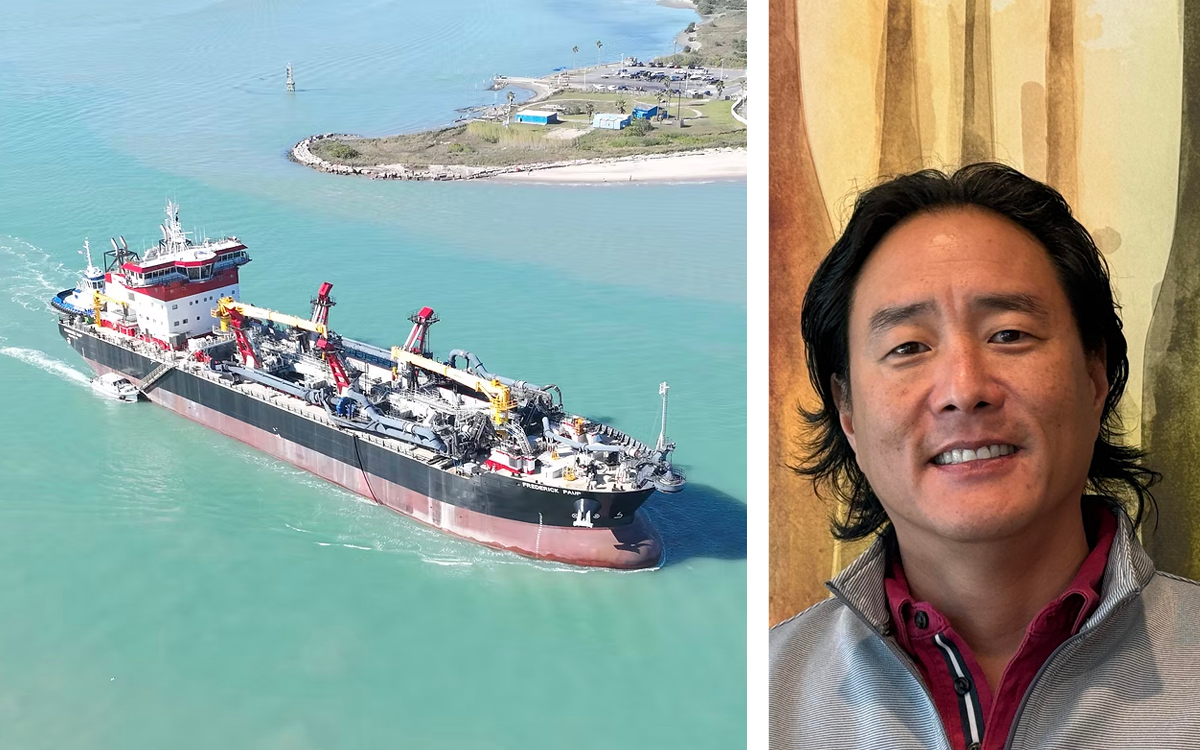
Capt. Eric Wong, Manson Construction Co.
Eric Wong, captain aboard Manson Construction Co.’s newest and biggest hopper dredge, the Frederick Paup, grew up in La Ciudad de Panamá, the capital city of Panamá, with the Panama Canal and the ships traversing it looming large. Even from a young age, Wong knew about the pilots that guide ships through the canal.
“Growing up in Panama is what led me to the maritime industry,” Wong said.
When it came time for college, Wong applied and was accepted to the California State University Maritime Academy in Vallejo, Calif. He graduated in 2001 and spent a short time working a union job before going to work for Manson, filling in for a mate.
“I decided, you know what, I’ll give it a shot,” Wong said. “That was it. I stuck with dredging.”
Wong’s first vessel with Manson was the Bayport, a trailing suction hopper dredge that debuted in 1996 and that measures 303 feet by 54 feet. Wong said he was immediately drawn to the challenge of piloting a dredge compared to ocean-going commercial ships.
“You’re maneuvering in tight channels, and you’re dealing with traffic,” he said. “Everything was a hands-on experience versus shipping deep sea, where you have open oceans and, when you come to port, you pick up a pilot, and he brings you in. Dredging was definitely fun.”
Wong said his first assignment aboard the Bayport was Georgetown, S.C., an area with steep banks and strong currents.
“You had to put the bow into the bank in order to turn the vessel around at certain tides,” he said. “Coming out of school, you stay away from all objects, buoys, you stay between the buoys. And then these were Z-drives versus just conventional shipping. It was just phenomenal.”
Wong explained how the mate, working under the captain, is in charge of navigating the dredge from point A to point B, and coordinates when to lower and pick up the drag arms. The mate also conducts safety inspection walks and deals with other vessel traffic.
Initially, Wong worked four weeks on and two weeks off with Manson, which worked perfectly for a recent graduate with loans.
“That was perfect,” he said. “I paid off my student loans in no time.”
Wong now works a three and three schedule, he said.
Reflecting on his 24 years with Manson, Wong highlighted the safety culture that’s grown, not just at Manson, but throughout the maritime industry.
“Now, you actually sit down, you do the JSAs [Job Safety Analyses], you talk about the project evolution, and you get input from the crew,” Wong said. “Whereas before, as long as one person knew what was going on, that person would delegate as you do the project or the task.”
Wong said that collaborative approach not only aids project execution and safety but also improves a crew’s sense of team.
“The crew is what makes being away from home enjoyable,” Wong said. “Everybody brings something to the table. You determine what is their strong point, where are their values, and what is their expertise. Everything adds up, and everything will help in the completion of a big task.”
Wong also emphasized how receptive Manson is to safety concerns and feedback from vessel crews.
“What a pleasure to work for a company that prioritizes trust over micromanaging, which allows for a safer and more productive environment,” he said. “I really enjoy the shore support we get and the fact that Manson addresses issues of safety and is willing to make changes to make things better.”
Before moving over to the Frederick Paup, Wong was chief mate aboard the Glenn Edwards, a 390-foot by 76-foot hopper dredge with a 38-inch suction and discharge diameter and a hopper capacity of 13,500 cubic yards.
Wong said a major difference between the Glenn Edwards and the brand-new Frederick Paup is that the latter features diesel-electric power versus conventional diesel propulsion. Wong said the smoothness of diesel-electric took some getting used to.
“Before you would feel and hear everything,” he said. “When you’re maneuvering now, everything’s more quiet.”
Of course, another big difference is the sheer size of the Frederick Paup, compared to the Glenn Edwards and the Bayport. The Frederick Paup is 420 feet long and 81 feet wide and boasts a hopper capacity of 15,150 cubic yards. That’s 30 feet longer than the Glenn Edwards and more than 100 feet longer than the Bayport. Still, Wong pointed back to the Bayport and all working on that vessel taught him.
“I think everybody should start that way [on a smaller dredge], because if you want to learn, that will give you a full picture and understanding of the operations, what the crews need and project challenges,” Wong said. “I think that played a huge role in me being interested in the dredging side of things.”
Reminiscing on his time with Manson, Wong recalled a time when he was serving on the Bayport when it was transitioning between East Coast and West Coast jobs. That transfer took him through familiar territory—the Panama Canal.
“Since I speak Spanish and am from there, I actually did the whole transfer myself,” he said. “I asked to stay the last hour just to complete it. I had family at the different locks just waving and seeing the vessel.”
The Frederick Paup is in the midst of its first assignment in Mobile, Ala., since its delivery from Seatrium AmFELS in Brownsville, Texas, last month. At the time of his interview with The Waterways Journal, Wong was off-watch and at home with his wife and kids, with Capt. Mike Coffey on duty aboard the Frederick Paup.