Dravo Goes Back To Peacetime Construction
Dravo Corporation’s Neville Island, Pa., shipyard was a large producer of many types of vessels during World War II. After the Ernest T. Weir and Albert E. Heekin were completed for Campbell Barge Line in 1941, production shifted entirely to military craft. First off the ways in 1942 were sub chasers and minesweepers. In December 1942, LST 1 was launched, and Dravo would build some 145 of those vessels during the conflict that ended with Germany surrendering in May 1945 followed by the Japanese surrender that August.
Dravo must have had drawings prepared or being prepared for new towboats well prior to the end of the war as the June 2, 1945, issue of The Waterways Journal noted that Dravo had completed 15 new barges for its Keystone Sand Division and “assembling of plates and shapes for a hull for the first of two 750 hp. towboats for the Keystone Division is underway.”
The Pittsburgh News column of the June 23, 1945, issue of the WJ said, “The first of two twin-screw towboats for the Keystone Sand Division, to be named Keystone, will be launched in 30 days.” It went on to say, “These boats will be 145 by 27 by 11.9 feet. Diesel engines developing 760 hp. will be installed. This power will be stepped up 30 percent through kort nozzles.”
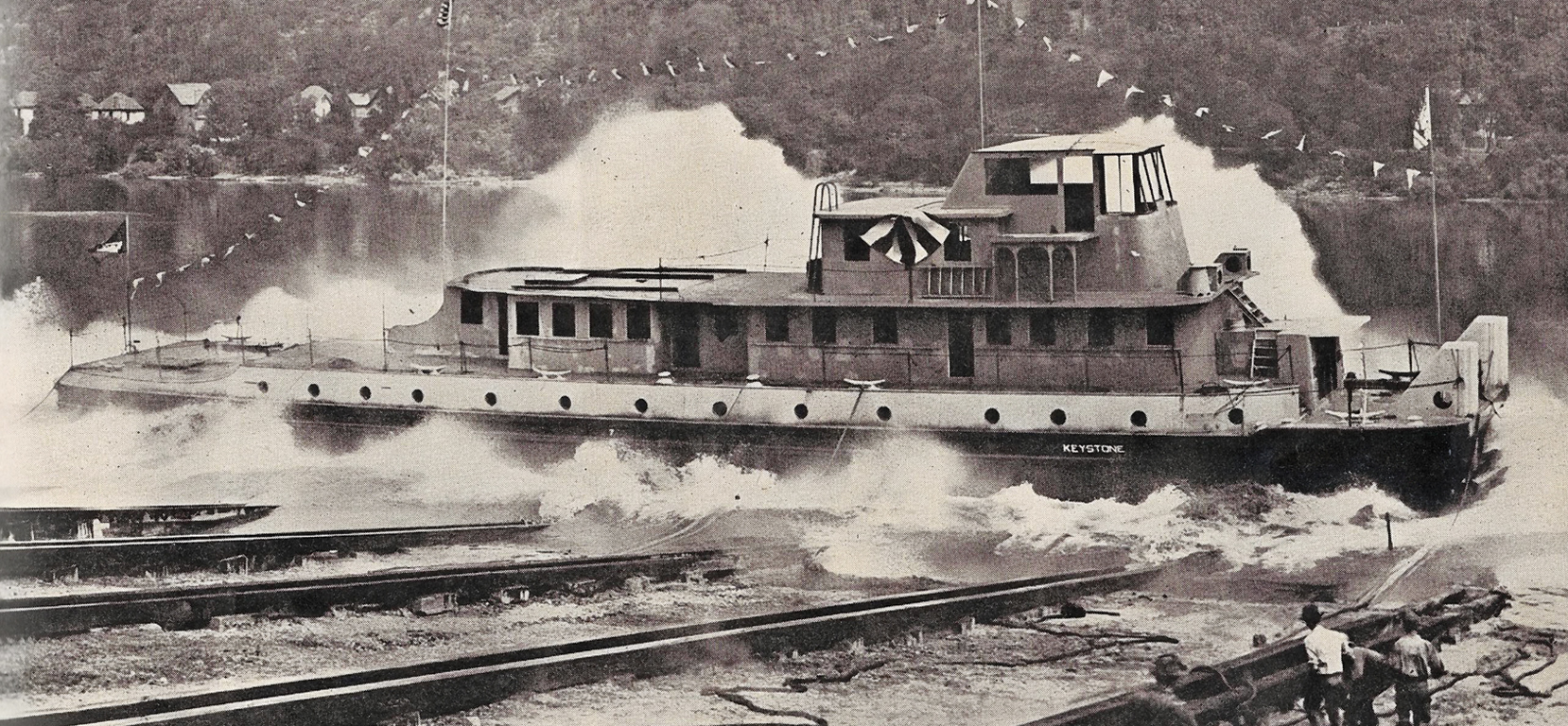
The July 25, 1945, WJ carried a large center section feature story on the new Keystone, including a photo of the launch of the new boat at Neville Island on July 18. It was the first launch of a commercial towboat at the facility since that of the Albert E. Heekin on March 11, 1941. The Keystone was christened by Mrs. A.J. Hippert, wife of the general superintendent of Keystone Sand.
The article touted the performance of the four previous boats of this class built by Dravo in 1940-41, the Ductillite, Victory, Semet-Solvay and Albert E. Heekin. The Heekin was built 10 feet longer in hull than the first three and shared the same measurements as the new Keystone. All had Cooper-Bessemer engines of 760 hp. with 66-inch wheels turning in kort nozzles. The piece said that the previous vessels had “consistently proved themselves capable of carrying overloads and pushing their normal loads at comparatively high speeds.” They had also shown great economy in ton-mile cost and in maintenance.
The new boat had a “raised deck” with port holes for the quarters located there that were partially below the waterline. Accommodation for eight crew members was in the forward section, and the galley and dining room were located in the after section behind the engine space. The upper cabin was longer than on the earlier vessels and had space for 11 crew. The small cabin aft of the pilothouse had spaces for the captain and pilot. The pilothouse was set down forward of this, pool style.
The front of the pilothouse was slightly angled back, and certain other streamlined features set this new boat apart from the previous four. The stack would be larger in diameter and shorter. The WJ article gave the amount of sheer forward as 2 feet, and sheer aft as 9 inches. The camber of the main deck was shown as 6 3/4 inches in the 27-foot width. These figures led to a very pleasing appearance, extending under water to the very shapely model bow hull.
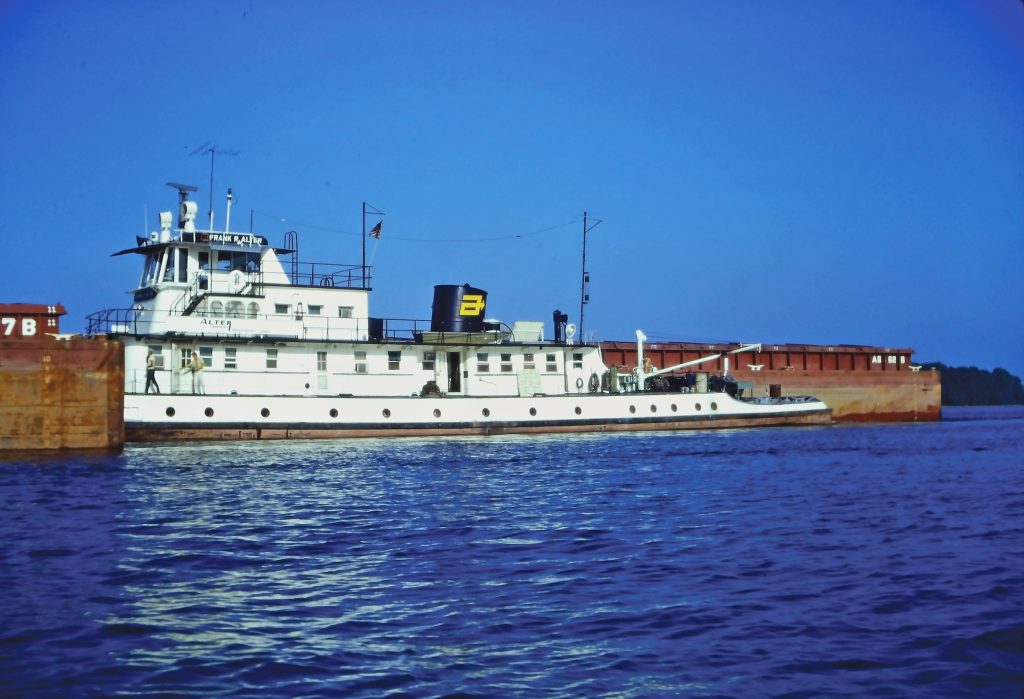
The Keystone was operated in the Sand Division, sometimes on charter to Union Barge Line, another Dravo subsidiary until sold in 1960 to Alter Company, Davenport, Iowa, and renamed Frank R. Alter. This was the first vessel in the Alter fleet, and Alter later purchased the Buckeye, a sister vessel to the Keystone, naming it Col. Davenport.
In 1979, it was sold to Ro-Bar Marine Services, Inc., St. Louis and renamed Barbara Jeanne Meyer. At the same time, it was repowered with GM 12-567B engines and Falk 2.5:1 gears, giving it 2,200 hp. In January 1984, it was sold to Sutton River Service, Inc., Mapaville, Mo., and renamed John R.
The boat was shown in the “Off the Record” section of the 1987 Inland River Record as having been sold to Whitehorse Marine Inc., Norfolk, Va., in April 1986. The story would probably end here if not for the detailed notes of the late Dan Owen, long-time editor of the Inland River Record. They say that the boat was renamed Jenna B by Whitehorse and used in the Chesapeake Bay area. It sank to the pilothouse in 1994, and, after salvage, it was offered for sale at auction, but there were no bidders.
When the boat was sold to Alter in 1960, Dravo must have retained the bell. Also in 1960, Dravo took the James D. Francis in on a trade with Island Creek Coal, renamed it Keystone, placed the bell from the 1945 Keystone on it and sent it to its subsidiary, Potomac Sand & Gravel, Washington, D.C. This boat came back to the Ohio River in 1973 as the Robin B for C&J Towing, Ashland, Ky., and the bell is now in the possession of this writer.
Featured photo caption: Launch of the Keystone at Dravo July 18, 1945, pictured in the July 28, 1945, WJ. (Photo from the author’s collection)