
Study: Lower Miss Ship Channel Fuels $226.5 Billion Annual Impact
The Big River Coalition, which is dedicated to promoting the economic and navigational interests of the Mississippi River Ship Channel (MRSC), has released a new comprehensive economic impact study on the ship channel. The report, funded by the Louisiana Department of Transportation and Development (LaDOTD) and conducted by Polaris Analytics and Consulting (with assistance from Big River Coalition), found that the Mississippi River Ship Channel supports an average of $226.5 billion in annual trade value through the New Orleans Customs District.
That average annual impact amounts to $620.4 million per day and represents roughly 20 percent of all waterborne cargo volumes in the United State.
“This study quantifies the immense value of the Mississippi River Ship Channel to our nation’s economy and underscores the urgent need for sustained infrastructure investment,” said Sean Duffy, executive director of the Big River Coalition. “Disruptions not only drive up freight costs and weaken farmer basis but also plant ‘seeds of doubt’ among global buyers, risking long-term cargo diversions and lost U.S. export sales.
“We must prioritize maintenance and deepening to ensure reliable navigation for generations to come,” Duffy concluded.
The Mississippi River Ship Channel extends from Baton Rouge, La., to the Gulf via Southwest Pass, connecting the “hinterlands” of the United States to world markets. The network of inland waterways that ultimately lead to the mouth of the Mississippi amounts to more miles of navigable waterways that in the rest of the world combined, according to the announcement from the Big River Coalition. The ship channel connects five deep-draft ports in Louisiana: the ports of Greater Baton Rouge, South Louisiana, New Orleans, St. Bernard and Plaquemines, which recently rebranded as the Louisiana Gateway Port. Those ports alone facilitate $99.7 billion in annual trade value, based on unified volumes, or $273.1 million daily.
From 2014 to 2023, U.S. imports through the New Orleans Customs District averaged $117 billion annually, while exports averaged $109.5 billion annually. Cargoes moving through the New Orleans Customs District originated or were bound for more than 200 countries, with top import origins including Russia and Brazil and top export destinations including China and Mexico.
The economic impact study found that the Mississippi River Ship Channel dominates cargo handling in the United States with an average of 470 million short tons annually from 2014 to 2022—nearly double that of the Houston Ship Channel during the same period. The study also highlighted the connections between shallow-draft barge movements from throughout the Mississippi River Basin and deep-draft vessel movements along the ship channel, particularly for commodities like grains, soybeans, coal, petroleum products and fertilizers.
A critical focus of the Polaris Analytics and Consulting report is the economic vulnerabilities to the nation from navigation disruptions, such as draft restrictions and closures. An unplanned 12-hour closure, for instance, could result in up to $3.8 million in lost output and $876,000 in lost labor income. A two-week closure could result in $194.8 million in impacts to total sales, including effects on water transportation, port operations and grain storage.
Per-foot draft restrictions lasting more than two weeks could result in losses of up to $5.5 million in sales (at a 43-foot draft level) to the local parish economies. Draft restrictions below the ship channel’s normal depth would cause ocean freight rates to rise by $0.92 to $1.05 per metric ton per foot of draft lost on a typical dry bulk vessel. A rise in freight rates would make Lower Mississippi ports and terminals less competitive with other U.S. ports and would weaken the United States’ competitiveness with other producers around the world.
“LaDOTD is proud to fund this vital research, which demonstrates the MRSC’s pivotal role in supporting Louisiana’s economy and the broader Mississippi River system,” said Julia Fisher-Cormier, deputy secretary of LaDOTD, who was recently hired as the next executive director of the Port of South Louisiana. “The findings highlight how even short disruptions can ripple through supply chains, affecting jobs, trade competitiveness and regional growth. This report will guide our efforts to enhance resilience and efficiency in our waterways.”
Capt. Michael Miller, chairman of the Big River Coalition and president of the Associated Branch Pilots, which guide ships between the Gulf and Head of Passes on the Mississippi River, said the study confirms the fact that the ship channel is vital to the nation, not just Louisiana.
“This study provides the data we need to advocate for policies that protect this essential artery of American commerce,” Miller said.
The full report and executive summary are available at www.pacanalytic.com/mrsc.
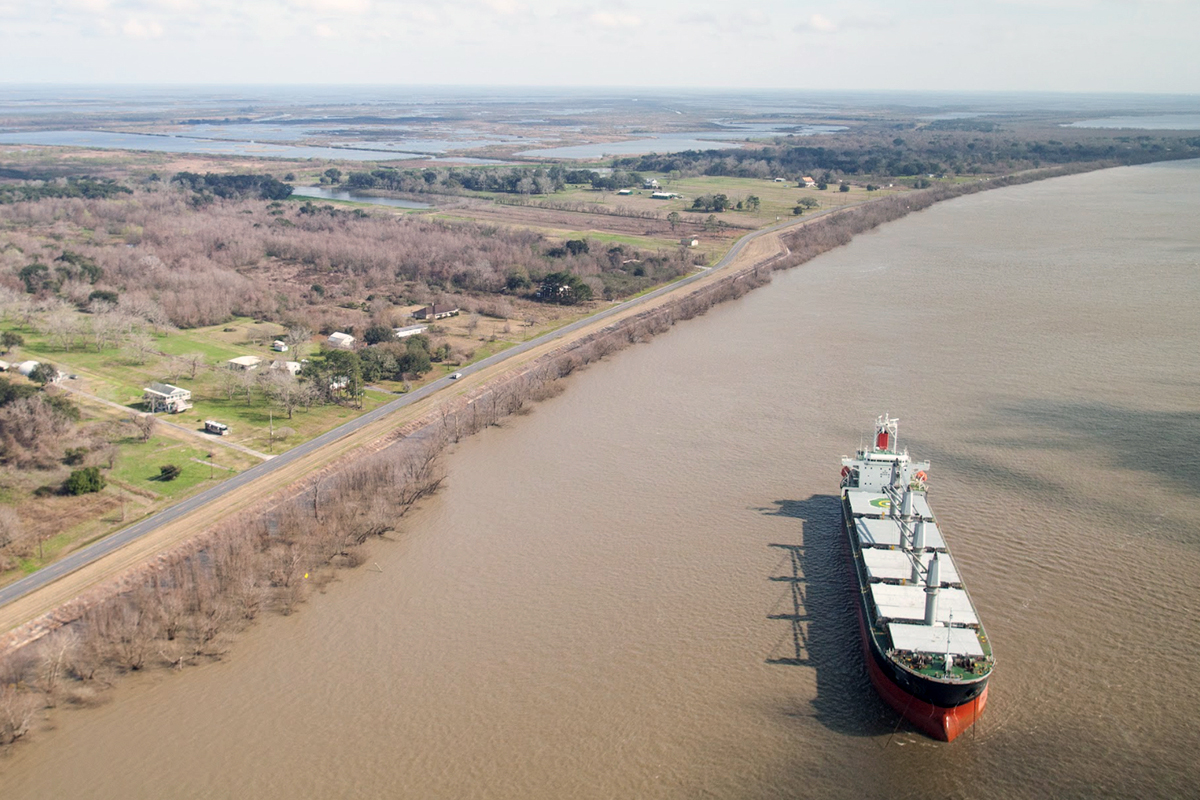
Photo caption: A ship heads upriver on the Lower Mississippi River, with the east bank of Plaquemines Parish in the background. (Photo by Frank McCormack)