

OBC: A Steamboat That Was The Last Of Its Kind
The Old Boat Column tends to detail a lot of vessels that became “firsts” of their kind, but, for a change, the next two weeks it will look at two boats that were “lasts.”
The Kahlke brothers, John, William and Peter, were born in Germany and made their individual ways to the United States. In the 1860s, they built and ran a drydock at New Orleans. Within a short time, that venture was over, and they moved north to Port Byron, Ill., on the Upper Mississippi River. They would soon move on to Rock Island, Ill., where they established a shipyard.
According to a history of the Kahlke business by Jerry Canavit that appeared in the S&D Reflector in 2009, the Rock Island facility was set up to build new vessels and also had a marine railway by which existing vessels could be hauled out of the water for repairs. The boatyard opened on leased property in 1868 and became very successful. In 1884, the Kahlke brothers purchased another property and moved the boatyard. Younger brother Peter wound up in charge of the business until he died in 1924 at age 86. His son, Fred, then took over the family business.
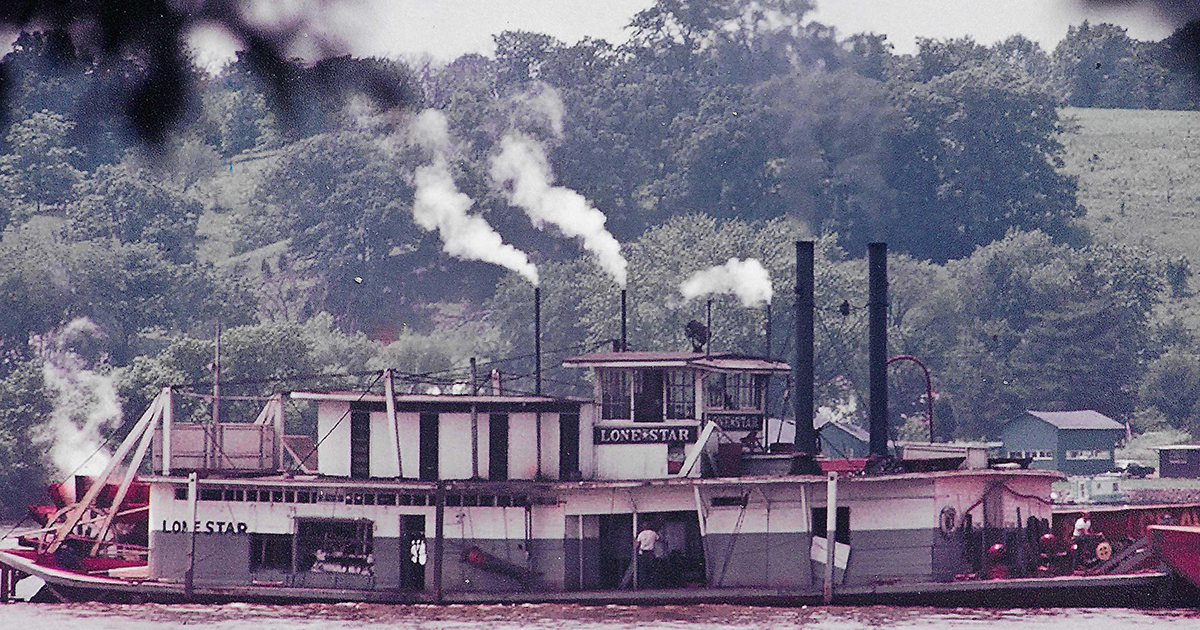
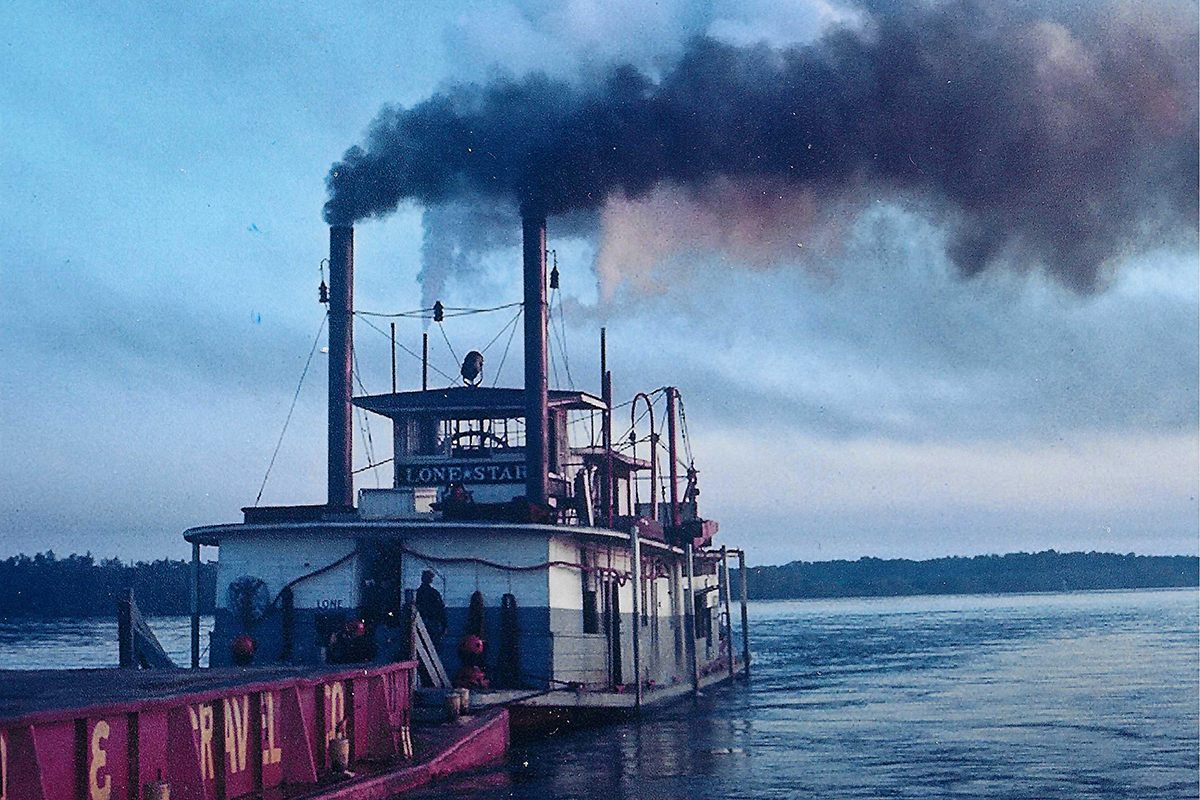
The Kahlke firm had always worked in wood and chose to continue in that medium even after iron and steel hulls came to prominence. In 1922, the yard built a new boat for the Builders Sand & Gravel Company of Davenport, Iowa, named Lone Star. This boat was a sternwheel steam towboat of all wooden construction with a hull that was 90 feet by 24.5 feet. It was originally rated at 140 hp. with engines that were 12’s, five-foot stroke. It was single deck with a slightly raised pilothouse and twin stacks forward of that. At some point, a cabin was added behind the pilothouse.
Some histories indicate that this boat was originally built in 1868 at Lyons, Iowa, as a sidewheel packet named Lone Star that was converted into a towboat in 1876. It was then reputed to have been rebuilt by the Kahlke yard at Rock Island in 1890 as a sternwheel steamer, which was last listed in 1921. The last boat was built in 1922, and it most likely had the machinery from the second vessel and may even have had some pieces from the 1868 Lone Star. If it did indeed descend from the first vessel, it would have been as Capt. Fred Way has described such boats as “being somewhat like the old family axe that had two new heads and three new handles. Not much of the original remained.”
By the 1940s, the work at the Kahlke yard was mostly the repair of wooden vessels, with some new pleasure boat construction. In 1957, the Lone Star was hauled out there and received extensive hull repairs. After this rebuild program, the Inland River Record listed the horsepower of the boat as 340.
It continued to operate out of Davenport, Iowa, until the evening of August 28, 1967, when it was cooled down after a final trip. The crew at the time included Capt. Glenn Johnson, master/pilot; William Horlas, engineer; Dick Schmidt and Louis Chapman, firemen/deckhands; and Mrs. Glenn (Eleanor) Johnson, cook.
At this point, the Lone Star was described by Capt. Way in the S&D Reflector as having been the “last of the Mohicans,” since with it ceasing operation, there were no other steam sternwheel towboats in service on the Mississippi River system. In fact, the only other steam towboat at that time still working was the DPC steam prop towboat Mateur, then operated by the Vicksburg Engineer District.
Builders Sand & Gravel replaced the little steamer with a new 760 hp. twin-screw diesel boat named Lady Lone Star that was built by Maxon Construction at Tell City, Ind. The steam Lone Star was acquired by the Buffalo Bill Museum at LeClaire, Iowa, and remains there today, intact and sitting on the bank within a metal and glass enclosure to ensure the continued preservation of the historic vessel.
The 1957 refurbishment of the Lone Star was the last major job completed by the Kahlke yard. It sat idle and decaying for years, and the city purchased rights to build a floodwall through the property in the late 1960s. Construction of the floodwall destroyed much of what was left.
Featured image caption: The steamer Lone Star pushing a tow. (Photo from the collection of Capt. Bill Judd)