

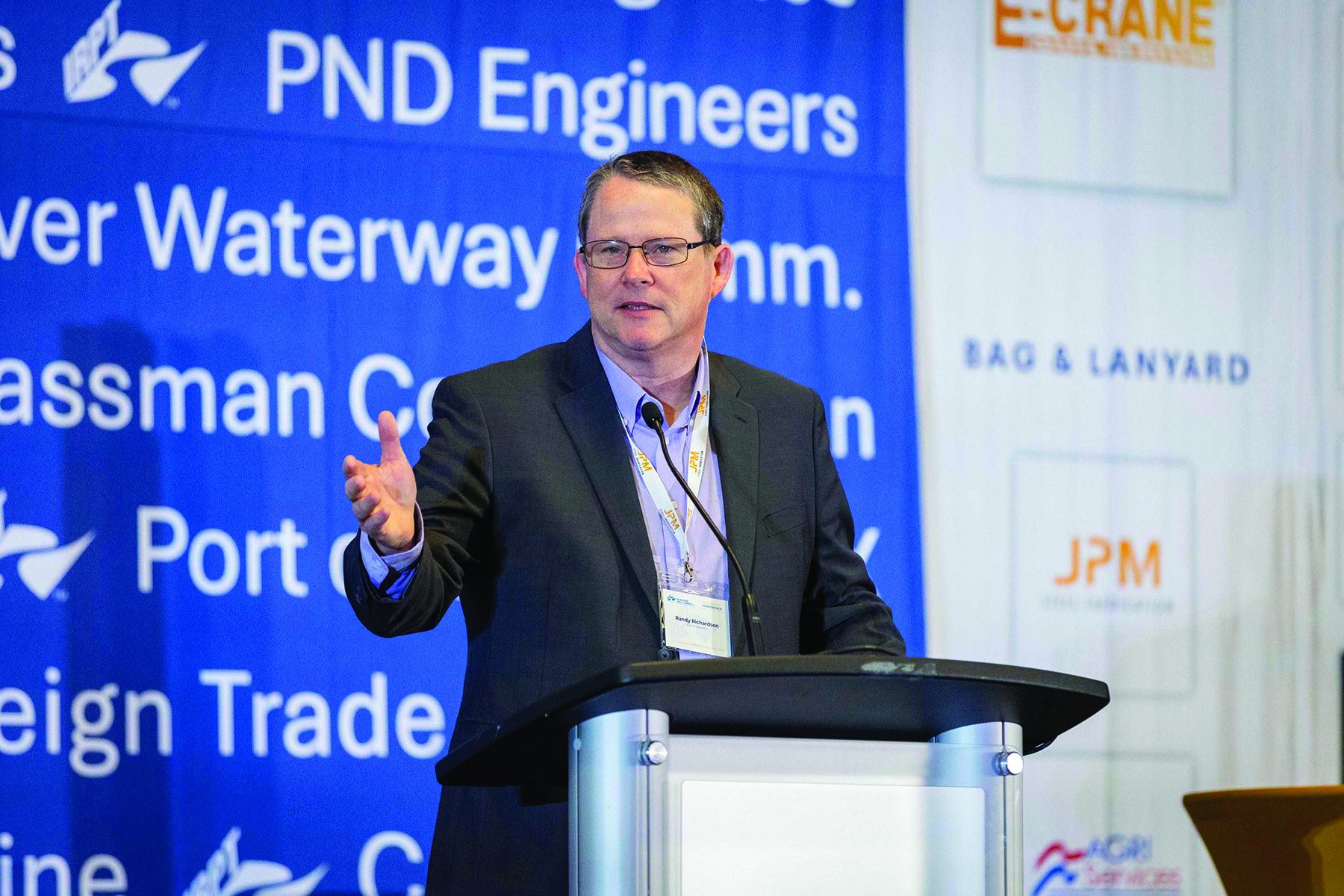
IRPT Meeting In Kansas City Covers Broad Agenda
Barge industry and terminal operators converged on Kansas City, Mo., on September 1 to 3 for the annual meeting of Inland Rivers, Ports and Terminals (IRPT), a non-profit trade association with more than 300 members nationwide that advocates for the industries and companies that serve and utilize inland rivers, ports and terminals.
The conference agenda covered a broad array of topics under the theme of “Navigating What’s Next,” including the outlook for commodities from salt to corn, soybeans and construction materials, energy markets, the impact of tariffs on inputs and commodities and growing opportunities for cargoes. Perspectives ranged from on-the-ground close-ups of particular cargoes and regions to broad surveys of the economy and its impacts to inland cargo movements.
After a welcome and port tour on the first day, the conference sessions opened with a presentation on how the Corps of Engineers’ Building Infrastructure, Not Paperwork initiative is “streamlining project delivery while maintaining environmental stewardship.”

Project Delivery Reform
Maj. Gen Jason Kelly, deputy commanding general for civil and emergency operations, touted the Corps’ “shifting (its) organization mindset” and “pivoting hard toward project delivery.” He praised the Kansas City Engineer District for handling 12 complex railroad closures and delivering $529 million in projects under budget and ahead of schedule.
Kelly admitted the Corps “has to change the way it does business” and said it was “taking a hard look in the mirror.” He pledged “No more starting construction before the blueprints are finished,” and he said the Corps is now committed to having at least 35 percent of design completed during feasibility studies, and 100 percent of design completed before actual construction. The target will be for the Corps to complete at least two major projects within an eight-year time window.
Kelly acknowledged that when it comes to aligning funding cycles with operations, the Corps “hasn’t yet been given all the tools and authorities it needs” by Congress, although it is being flexible with some tools it does have. He touted autonomous lock and dam operation and the use of more resilient materials in lock and dam construction, like fiber-reinforced polymers instead of steel, as providing better long-term value for taxpayers.
Shipbuilding Revival And Maritime Prosperity Zones
Tommy Kutz, managing director of Avident Advisors, a unit of Jones Walker LLP, gave a presentation on the shipbuilding revival that spent a lot of time on current proposals for creating Maritime Prosperity Zones. The maritime renaissance is real and bipartisan, he said, and will outlast the current

administration. He was skeptical over why the proposal only included 100 MPZs out of more than 9,000 Opportunity Zones, but said they could be “a tool to bring in manufacturers.” The proposal is still being discussed in Congress, and Kutz said MPZs are “the biggest political football” right now. Kutz also discussed the July 21 release of a study by the University of Michigan’s School of Naval Architecture and Marine Engineering titled “The Future of Shipbuilding in the Great Lakes St. Lawrence Region.” After looking broadly at the region’s brownfields, greenfields, shipyards and other assets, the study found that “the primary challenge facing the region is the underutilization of its existing industrial shipbuilding corridor, including its active shipyards, deep supplier base, skilled-trades workforce and technology ecosystem.”
Kutz believes that modularization is the key to using these assets to participate in the shipbuilding revival — in other words, breaking down the shipbuilding process into chunks that smaller shipyards and contractors can take part in. “We can look for more foreign-directed partnerships,” he said, like the existing partnerships with Korean and Finnish shipbuilding companies.
Commodities, Aggregate Demand
Paul Henderson, public works business development manager for Five-S Group, a major civil construction, marine construction and site development firm operating out of the Gulf South region, spoke on how the proliferation of data centers and other “mega-projects” has sent demand for aggregate, sand and gravel to new heights. Five-S has increased its pieces of large equipment by 600 this year alone, he said. The Port Arthur LNG project, for example, requires 4.5 million tons of bedding stone, and the Golden Pass LNG project in Sabine, Texas, used 1 million tons of stone.
Henderson asked the audience for “amens” when he mentioned large projects generating demand for millions of tons of construction materials.
Economic Overview
One of the most thought-provoking presentations was given by Jeremy Hill, an economic research analyst from the Federal Reserve Bank of Kansas City, who gave a broad overview of risk factors in the larger economy, focusing on agriculture, energy and manufacturing. U.S. agriculture is weakening, he said, even as other areas of the world, including Argentina, are growing and exporting more soybeans and building out their export infrastructure.
He jokingly used the Japanese term “wabi-sabi,” finding beauty in imperfect or broken things, to refer to the U.S. economy. There’s a demographic slowdown that is fostering worries about labor supply even as people simultaneously worry about artificial intelligence (AI) eliminating jobs, but Hill said the labor market is actually in balance right now compared to last year.
“We’re now right around our natural rate of growth, or new natural rate of growth, even though it’s much slower than it was before. Now that’s been internalized. A lot of people, economists are thinking that it’s OK and healthy where we’re at in the labor market,” he said.
Higher inflation remains a concern, Hill said, and it has several drivers other than tariffs. Prices of houses and cars continue to rise.
The manufacturing renaissance is contributing to inflation, as prices for raw material inputs in the steel sector, for example, have risen between 25 to 50 percent. Firms that used to try to limit their announced price increase to customers to once a year are raising them more frequently.
Oil and gas drillers have not yet increased production but are content to profit-take as they wait to see how the Middle Eastern conflict proceeds. “We are actually burning off some of our strategic oil reserves to help balance this, and we’re getting to the point in global supply where we’re having less and less oil, and that’s going to happen on supply and demand, more and more pressure to have energy costs go up in the future.”