
The Arthur J. Dyer Was Notable In 1951
In recent columns we have looked at vessels built by the Nashville Bridge Company (NABRICO) since the popular Inland Marine Expo (IMX) was held May 27–29 in Nashville, Tenn. First detailing the sternwheel Dixie of 1937, the column then looked at the big Lin Smith of a decade later to showcase the advancements made in vessel construction over those 10 years. Last week focused on the Harry Dyer of 1949, a boat named for the president of NABRICO at the time, who was also the son of the company founder.
The May 26, 1951, issue of The Waterways Journal noted in the Cumberland River news column that NABRICO founder Arthur J. Dyer was to turn 83 on May 27, and he would celebrate at Boxwood Hall, his farm home south of Nashville. An article on the same page said that Ingram Products Company head O.H. Ingram had announced that his company’s new boat under construction at NABRICO would be named after Arthur Dyer.
The August 4, 1951, issue of the WJ had a full-page ad for NABRICO that featured the new Ingram boat and was headed “The Nashville Bridge Company, now entering upon its 50th year in business, announces the completion of its 1,000th vessel, the new twin-screw diesel towboat Arthur J. Dyer.”
The next issue carried a full and detailed story by Donald T. Wright, owner/editor of the WJ, regarding the new Arthur J. Dyer. It carried NABRICO hull number 1,000, and two tank barges that had been built for it to tow had hull numbers 998 and 999. Ingram was a dedicated customer of NABRICO, having previously had three other towboats built there. The Dyer would be the largest for Ingram so far.
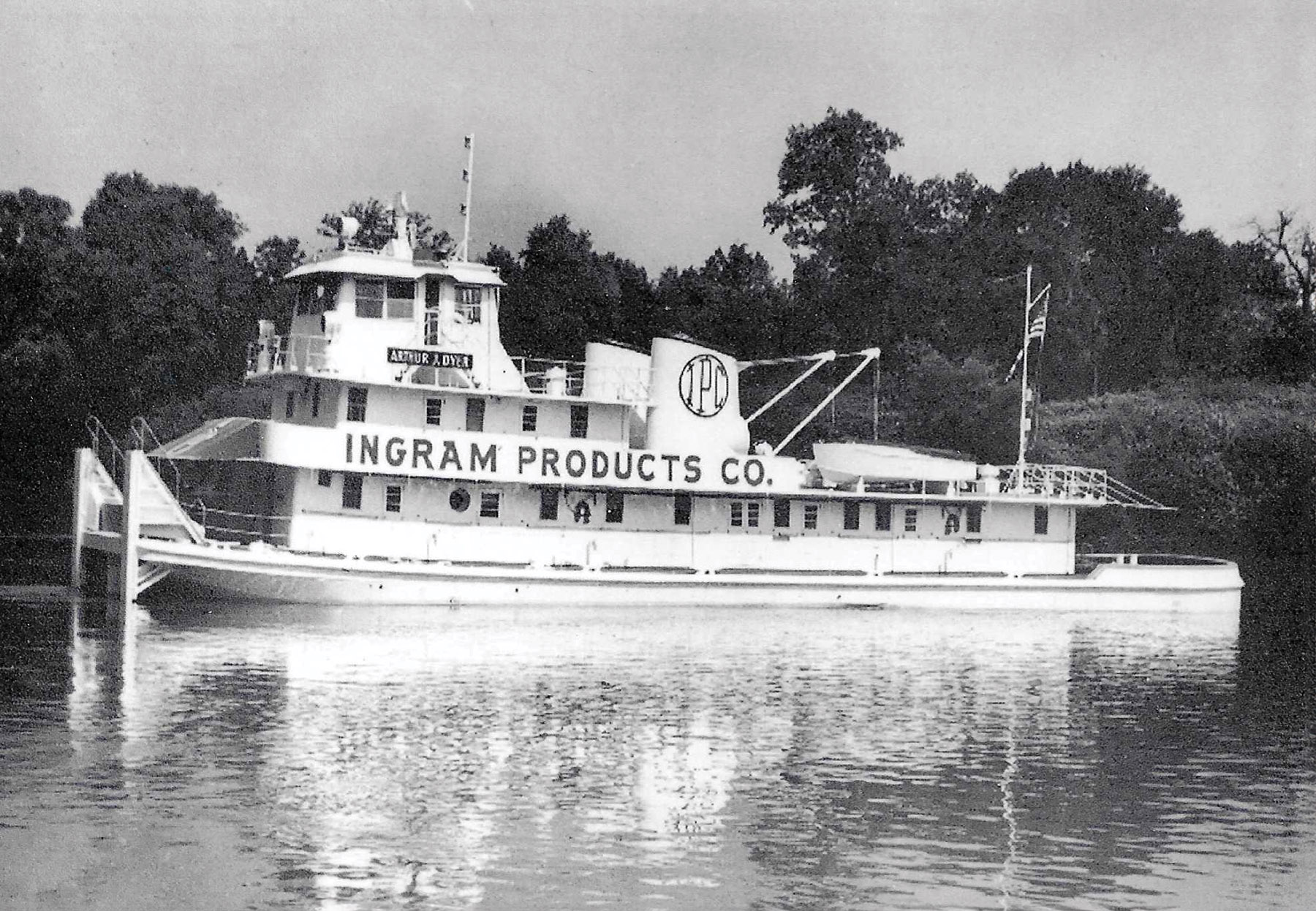
The new vessel had a steel hull that was 124 by 27.5 feet. A total of 1,800 hp. was provided by a pair of GM 12-567 engines and Falk gears. The boat had a full lower cabin with an open stern and a shorter second cabin on the upper deck surmounted by the slightly elevated, very distinctive NABRICO pilothouse. Two shapely smokestacks were aft of the upper cabin, each fitted with a boom for handling small boats.
Quarters were provided for a crew of 14, with additional space for guests. An open house was held aboard the boat at Nashville on July 31, 1951, and the next day it departed the NABRICO yard with the two new barges as well as the NABRICO towboat Caterpillar in tow. For the delivery trip to Paducah, Ky., Capt. Harry B. Dyer, president of the building firm, was aboard as master with Capts. Nobel Gordon and Walter Haas, pilots.
Guests aboard the Caterpillar for the delivery trip included Capt. C.W. Thomas, commander of the Second Coast Guard District, and his wife, as well as Mr. and Mrs. Donald T. Wright. The Wrights had travelled to Nashville in their car, which was loaded aboard the Caterpillar for the trip south. In the article, Wright said that the car was “a 1951 Packard that Mrs. Wright is mighty proud of,” and he was grateful for the care NABRICO took in loading it.
At Paducah, the Dyer was officially accepted by Ingram. With Capts William F. Edwards and Joe Holland aboard, the boat departed south for Cairo, Ill., and was then to proceed back up to Louisville for the first trip. The Caterpillar returned upbound to Nashville on the Cumberland River, stopping at Paris Landing, Tenn., where the Wrights’ Packard automobile was unloaded.
The Arthur J. Dyer would spend the next 34 years in service to Ingram Products Company and the succeeding Ingram Barge Company. In 1962, it was repowered with GM 16-567 engines and Falk 3:1 gears that gave the boat 3,200 hp. In October 1985, it was sold to Mainstar Towing Company, Tampa, Fla.
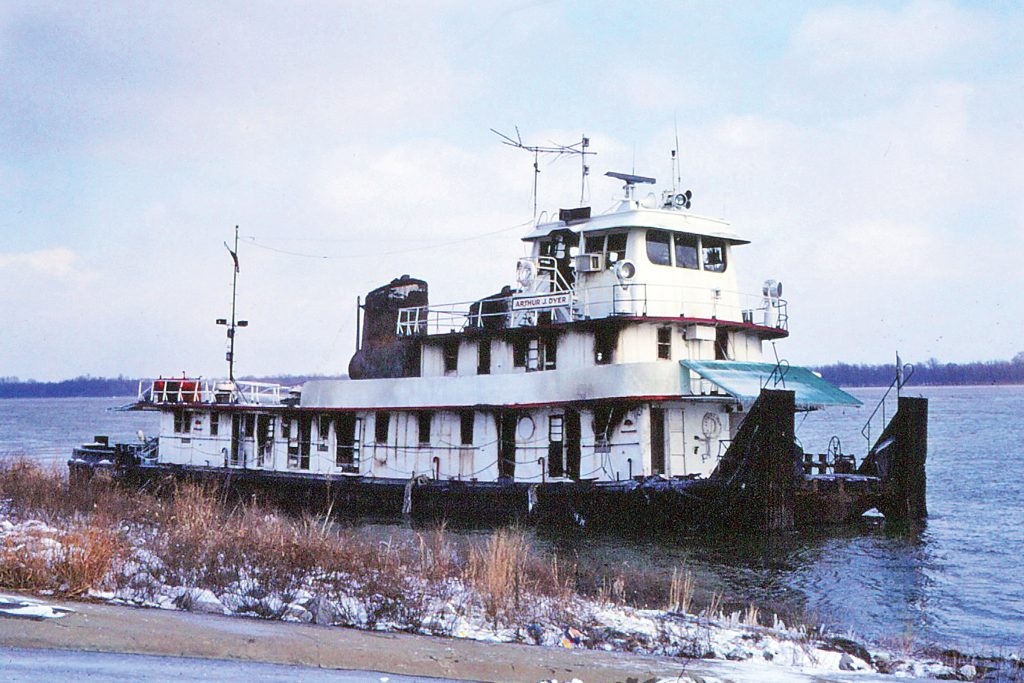
According to an article in the February 17, 1986, issue of the WJ, fire broke out aboard the Dyer while it was moored at the Molloy Marine Services facility at Paducah on February 11. Two shift boats moved it to the city front at Paducah, where the local fire department fought the blaze, hampered by single-digit temperatures, eventually extinguishing it about 3 a.m. the following morning. The Arthur J. Dyer was judged to be a total loss.
While in Nashville for the IMX, this writer noticed that his hotel room looked out over the Cumberland River at the six-story office building that had been built by NABRICO in 1908 and served as company headquarters for decades. While the building is now a pristine venue known as The Bridge Building, it is sad that the large NASHVILLE BRIDGE COMPANY markings no longer adorn it.