
Another ‘Porthole’ Towboat
In the August 17, 2026, issue of The Waterways Journal, this column detailed the Keystone, which was the first commercial vessel launched by Dravo Corporation at Neville Island, Pa., since the beginning of World War II. This week, the column will look at the second boat in this series, which came out just after the Keystone.
Dravo Corporation was a large producer of many types of vessels during the war. After the Ernest T. Weir and Albert E. Heekin were completed for Campbell Barge Line in 1941, production shifted entirely to military craft. First to be launched in 1942 were sub chasers and minesweepers. In December 1942, LST 1 was completed, and Dravo would build some 145 of those vessels during the conflict, which ended with Germany surrendering in May 1945 followed by the Japanese surrender in August of that year.
Dravo must have had drawings prepared or being prepared for new towboats well prior to the end of the war as the June 2, 1945, issue of The Waterways Journal noted that Dravo had completed 15 new barges for its Keystone Sand Division and that “assembling of plates and shapes for a hull for the first of two 750 hp. towboats for the Keystone Division is underway.”
The Pittsburgh News column of the June 23, 1945, issue of the WJ said that “The first of two twin-screw towboats for the Keystone Sand Division, to be named Keystone, will be launched in 30 days.” It went on to say, “These boats will be 145 by 27 by 11.9 feet. Diesel engines developing 760 horsepower will be installed. This power will be stepped up 30 percent through kort nozzles.”
The Keystone was launched at Neville Island on July 18, 1945. An article about the new boat in the July 25, 1945, issue of the WJ touted the performance of the four previous boats of this class built by Dravo in 1940-41, the Ductillite, Victory, Semet-Solvay and Albert E. Heekin. The Heekin was built 10 feet longer in hull than the first three and shared the same measurements as the new Keystone. All had Cooper-Bessemer engines of 760 hp. with 66-inch wheels turning in kort nozzles. The piece said that the previous vessels had “consistently proved themselves capable of carrying overloads and pushing their normal loads at comparatively high speeds.” They had also shown great economy in ton-mile cost and in maintenance.
The latest series of these boats had a “raised deck” with port holes for the quarters located there that were partially below the waterline. Accommodation for eight crew members was in the forward section, and the galley and dining room were located in the after section behind the engine space. The upper cabin was longer than on the earlier vessels and had space for 11 crew members. The small cabin aft of the pilothouse had spaces for the captain and pilot. The pilothouse was set down forward of this, pool style.
The front of the pilothouse was slightly angled back, and certain other streamlined features set the new boats apart from the previous four. The stack would be larger in diameter and shorter. The WJ article gave the amount of sheer forward as 2 feet and sheer aft as 9 inches. The camber of the main deck was shown as 6 3/4 inches in the 27-foot width. These figures led to a very pleasing appearance, extending underwater to the very shapely model bow hull.
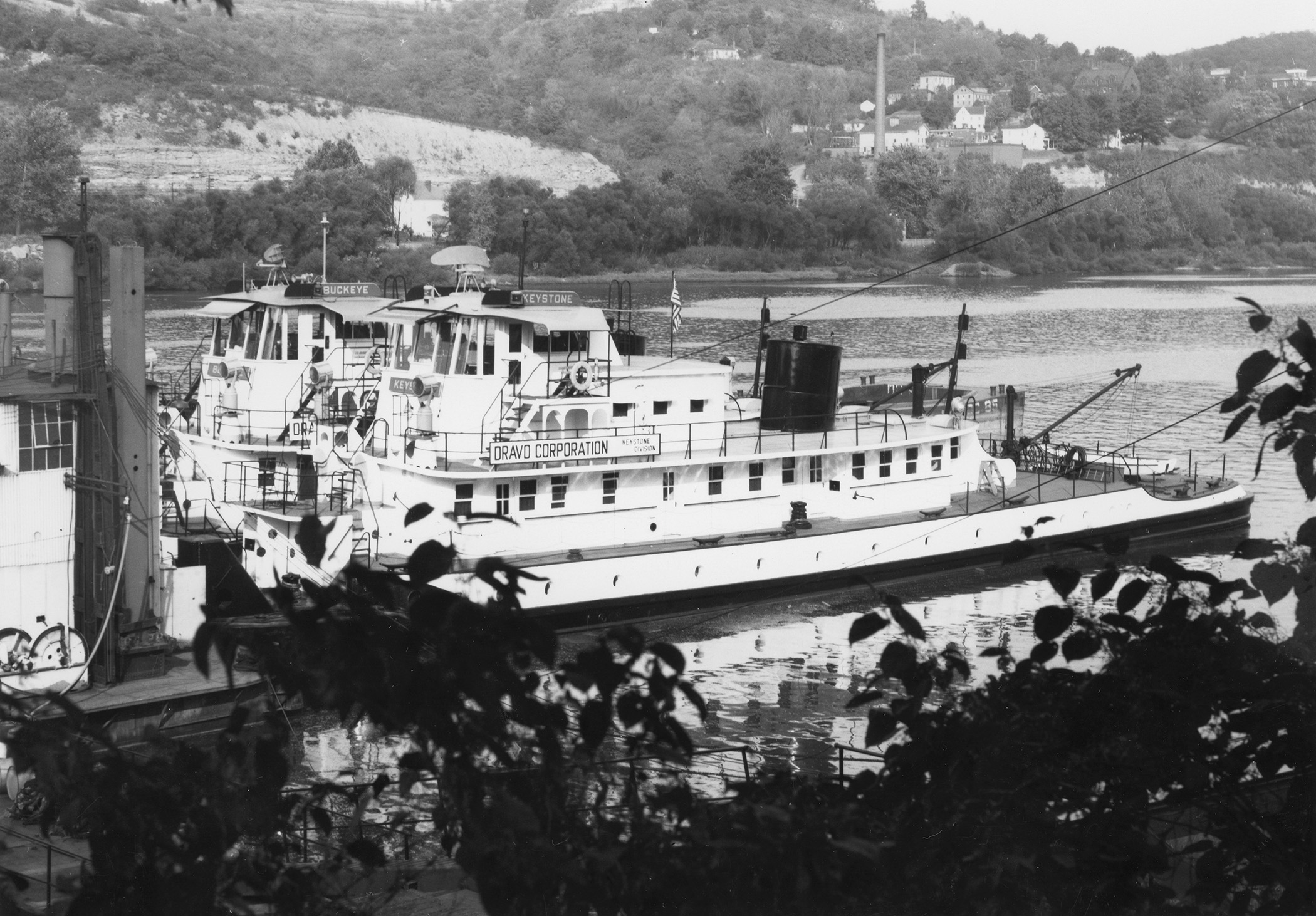
As is often the case, the second of these boats to come out in late 1945 did not receive the attention or the fanfare afforded the vanguard of the group. This second boat for the Dravo Keystone Sand Division was named Buckeye and entered service just after the Keystone. It worked in the sand trade in the Pittsburgh pools and was loaned out to Dravo subsidiary Union Barge Line at times.
In 1962, it was sold to Alter Company, Davenport, Iowa, which had purchased the Keystone in 1960. It was renamed Col. Davenport, and, for the next decade, it served in tandem with its sister vessel again. In April 1972, the boat returned to the upper Ohio River when it was sold to United Towing, Inc., East Liverpool, Ohio. It was renamed Mickey Dawson for a few weeks and then back to Col. Davenport.
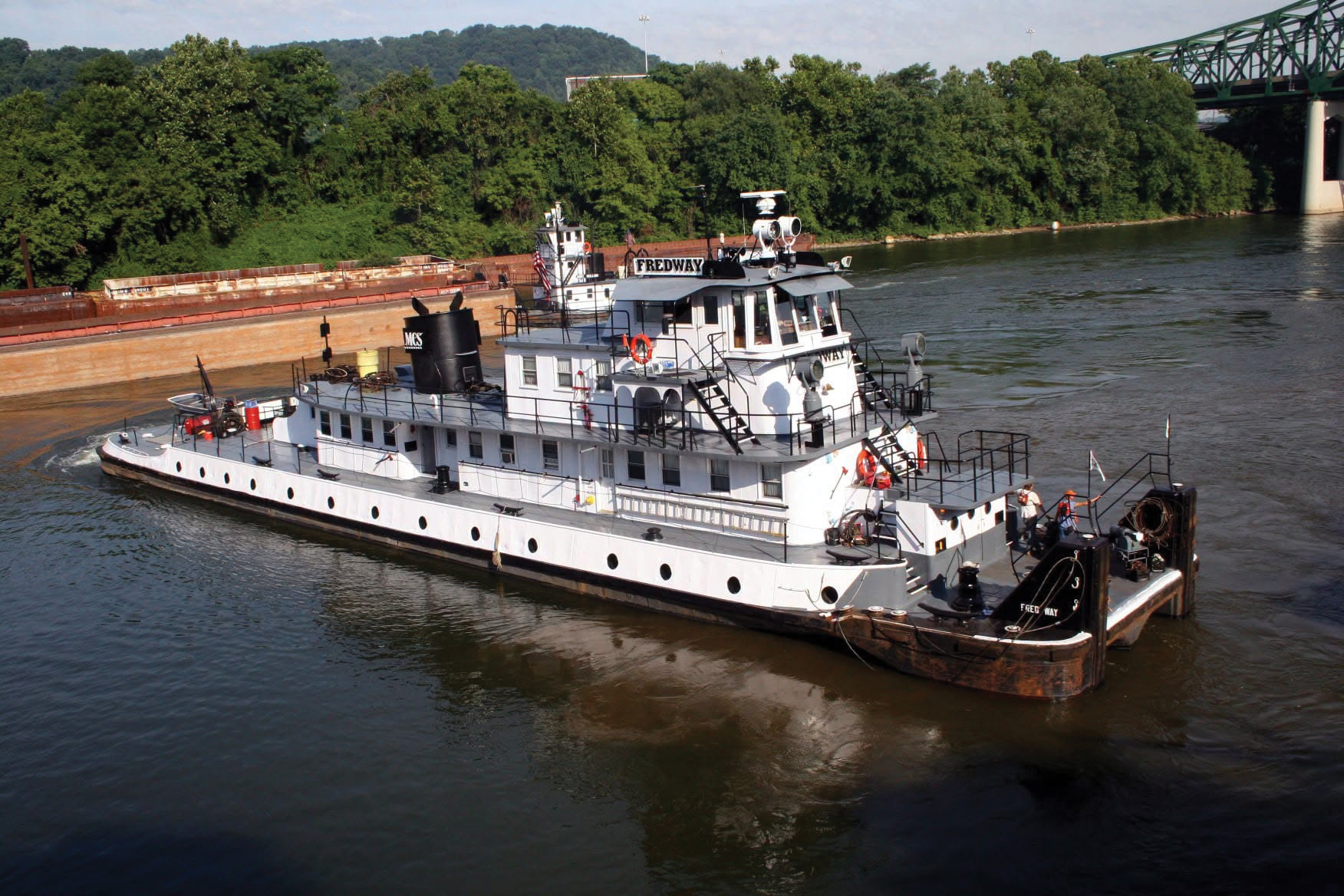
In 1976, it was sold to Union Boiler Company, Nitro, W.Va., and repowered with GM 12V-149 engines and Twin Disc 5.17:1 gears providing 1,350 hp. In January 1984, it was sold to Madison Coal & Supply Company, Charleston, W.Va. In September of that year, it was renamed Fred Way to honor noted riverman, historian and author Capt. Frederick Way Jr. When asked how he wanted the name on the boat he replied, “Just Fred Way.”
In 2003, the boat was again repowered, this time with Cummins KT38-M1 engines totaling 2,000 hp. In 2007, extensive hull work was done, including the installation of new kort nozzles and propellers designed especially for the boat by CT Marine. In 2010, the owning firm became Amherst Madison, Inc.
The boat last appeared in the Off The Record section of the 2018 edition of the Inland River Record as having been sold to Neale Marine Transportation, Parkersburg, W.Va., for use as a landing boat. Prior to this, the boat had been dismantled of the machinery by Amherst. Thanks to the efforts of the Neale family, this classic towboat, the last remaining example of the Dravo “porthole” class, continues in existence.
Featured photo caption: Sister vessels Buckeye (outboard) and Keystone moored together. (Photo courtesy of Capt. C.R. Neale III)