
This Sternwheel River Towboat Ran The Atlantic Intracoastal Waterway
When Zac Metcalf, editor of The Waterways Journal, asked if I had any “old boats” in memory that ran the Atlantic Intracoastal Waterway, this boat came immediately to mind. It has graced this column before but is certainly interesting enough to revisit.
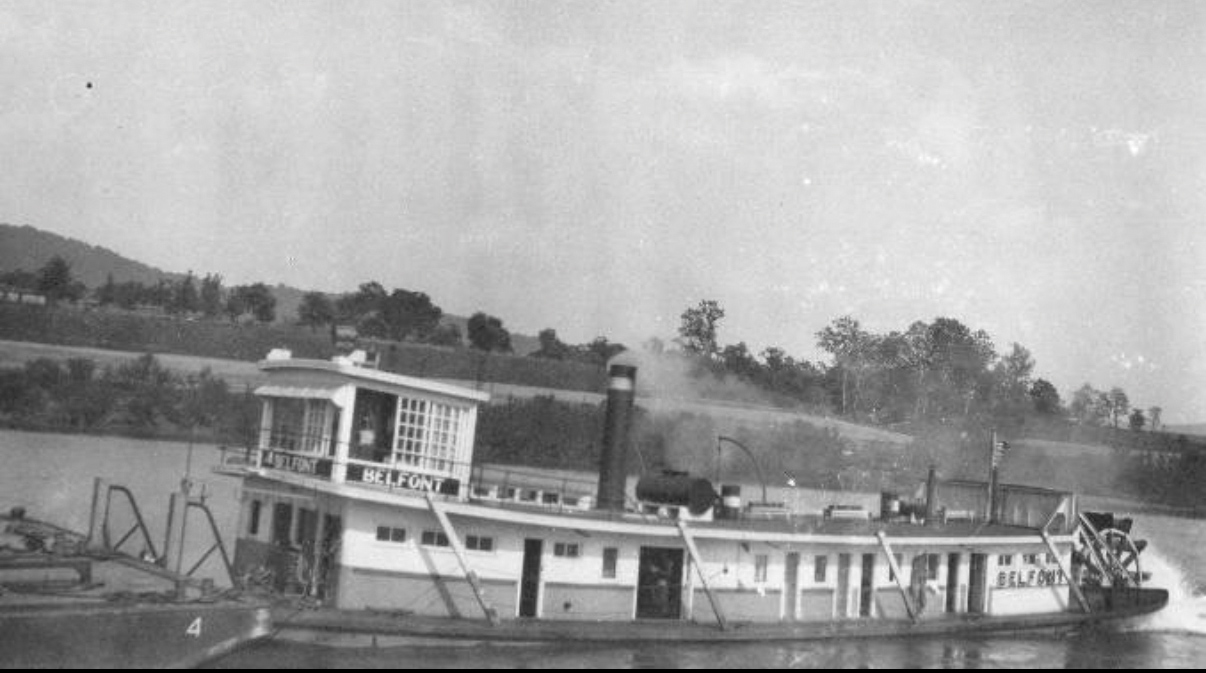
This boat was built in 1926 by the Marietta Manufacturing Company, Point Pleasant, W.Va., with a steel hull of 100 by 24 feet. It was named Belfont. The split sternwheel had a shaft-driven gear drive at the center of the wheel that was powered by a 360 hp. Fairbanks-Morse diesel engine. It was a single-deck vessel with a large pilothouse situated forward on the roof. The original owners were the Indiana-Belfont Transportation Company, Ironton, Ohio.
Just after midnight on May 24, 1928, the mv. Belfont was upbound on the Ohio River above Madison, Ind. The steam sidewheel packet Cincinnati was downbound after having departed Carrollton, Ky., and there was a collision between the two. Homer Johnston, an engineer aboard the Cincinnati, was killed.
The Waterways Journal of January 11, 1930, carried an ad by the Indiana-Belfont Transportation Company offering the boat for sale or lease. It was sold to Pure Oil Company, which renamed it R.H. McElroy Jr. and sent it far away to Mobile, Ala., where it operated on the Mobile and Tombigbee rivers. It had just begun its wanderings.
In 1939, Pure Oil transferred the boat to the Cape Fear River, and it ran between Wilmington and Fayetteville, N.C. In 1942, it attracted a lot of attention by making a trip up the Atlantic Coast with three gasoline barges in tow. In 1943, the mv. R.H. McElroy Jr. headed west when it was taken to Levingston Shipbuilding at Orange, Texas, and sponsons were added to the hull, increasing the width to 30 feet. The boat remained in operation on the Intracoastal Waterway, and, in 1945, it was repowered in Texas with a 375 hp. Fairbanks diesel. It may have been at this time that the gear drive to the sternwheel was converted to a chain drive system. In the fall of 1945, it again embarked on a long journey as Pure Oil transferred it to run on the Kanawha River in West Virginia. It was back home to where it had been built in 1926.
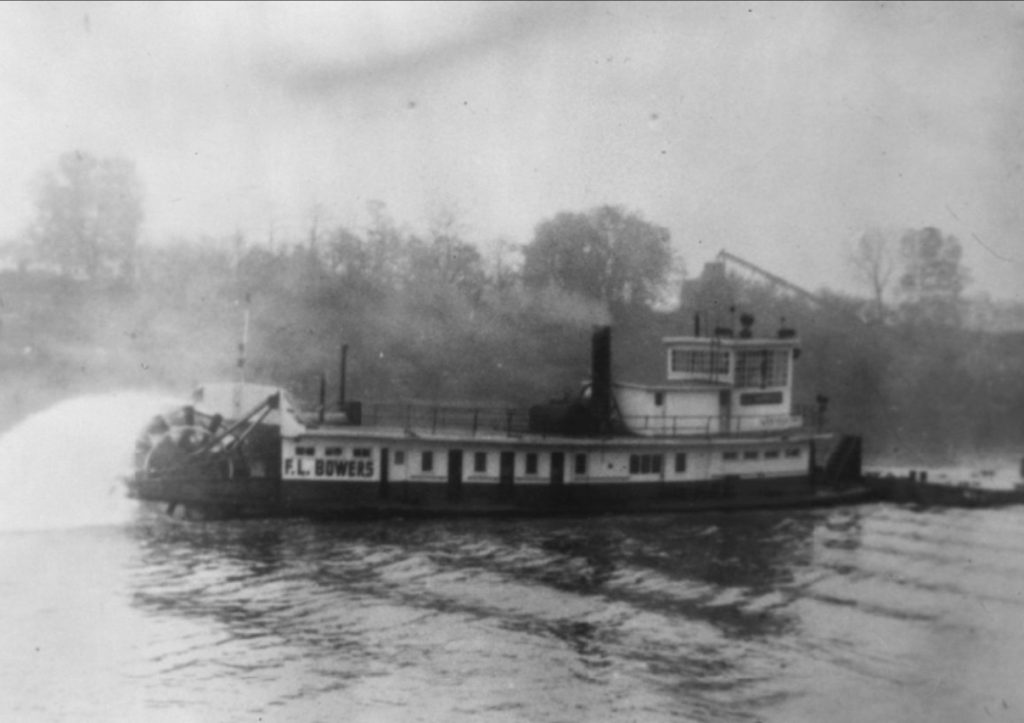
At some point during the boat’s career, the pilothouse had been raised several feet and a cabin placed aft of it. In 1948, the boat was sold to Capt. Edward Smith, Pittsburgh, who renamed it L.M. Smith. In 1954, it was sold to McClain Sand Company, Point Marion, Pa., and renamed F.L. Bowers. In the fall of 1956, it was sold again to Merdie Boggs & Sons, Catlettsburg, Ky. This was the second boat in the Boggs fleet. Capt. Merdie Boggs and son Capt. Clarence Boggs had gone in business in 1955 by purchasing the 120 hp. sternwheeler Resolute and doing shifting and harbor work in the Catlettsburg area.
The overall length of the mv. F.L. Bowers was over 120 feet, yet it was used in local harbor work at Catlettsburg and also made trips for Ashland Oil & Refining Company and other customers in short trade linehaul work. The radio call letters assigned to the boat were WH 3298.
Capt. Clarence Boggs and others have said that the Fairbanks engine on the boat was capable of more than 400 hp., and it was really too powerful for the boat. If run full ahead, the wheel would turn too fast, throwing water over the stern splashboard. Boggs also claimed that the Bowers was a poor backing boat, due, he felt, to the added sponsons on the side of the hull.
In 1960, Boggs traded the F.L. Bowers to Capt. Harry F. White, Belle, W.Va., for the dismantled steam sternwheel towboat Atlas, which the company utilized as a landing boat at Catlettsburg. White did not operate the boat very long, and it was dismantled on the Kanawha River about 1962. Thus ended the career of a widely traveled towboat.
Featured photo caption: The Belfont in operation. (Photo from the author’s collection)