
Another Towboat Named Kansas City
The last column dealt with a towboat built in 1955 for Sioux City and New Orleans Barge Line that was named Kansas City and operated on the Missouri River in the early years that it ran. This time we look at an earlier vessel that was also named for that unique city that straddles both Missouri and Kansas on the banks of the Missouri River.
The Inland Waterways Corporation (IWC) has been a favorite topic of this writer. River transportation had largely died out with competition from railroads and highways, and, when World War I started, the U.S. government realized that this vital asset was almost nonexistent. The result was the formation of the IWC as a government owned barge line with the intent to revitalize river transportation.
U.S. Army Maj. Gen. Thomas Q. Ashburn soon became head of the IWC, and he took his job seriously, earning the ire of critics such as the major national railroads. Ashburn persevered, and he built the barge line steadily over the years, also championing innovations such as prop-driven and diesel-powered towboats. In 1933, the IWC had two 1,180 hp. diesel towboats built by Midland Barge Company, Midland, Pa. These were the Franklin D. Roosevelt and Tom Sawyer.
In late 1937, it was announced that the IWC was planning three new towboats of the same design as the Roosevelt and Sawyer, as well as a tug for use on the Gulf Coast. One of the towboats would be named Helena and built by Midland, but the other two would be built at different yards. The Huck Finn would be built at Slidell, La., by Canulette Ship Building Company, and the final one by Marietta Manufacturing Company (MMC) at Point Pleasant, W.Va. The three towboats and one tug would be powered by steam machinery repurposed from the self-propelled freight barges Birmingham, Gulfport, Mobile and Tuscaloosa.
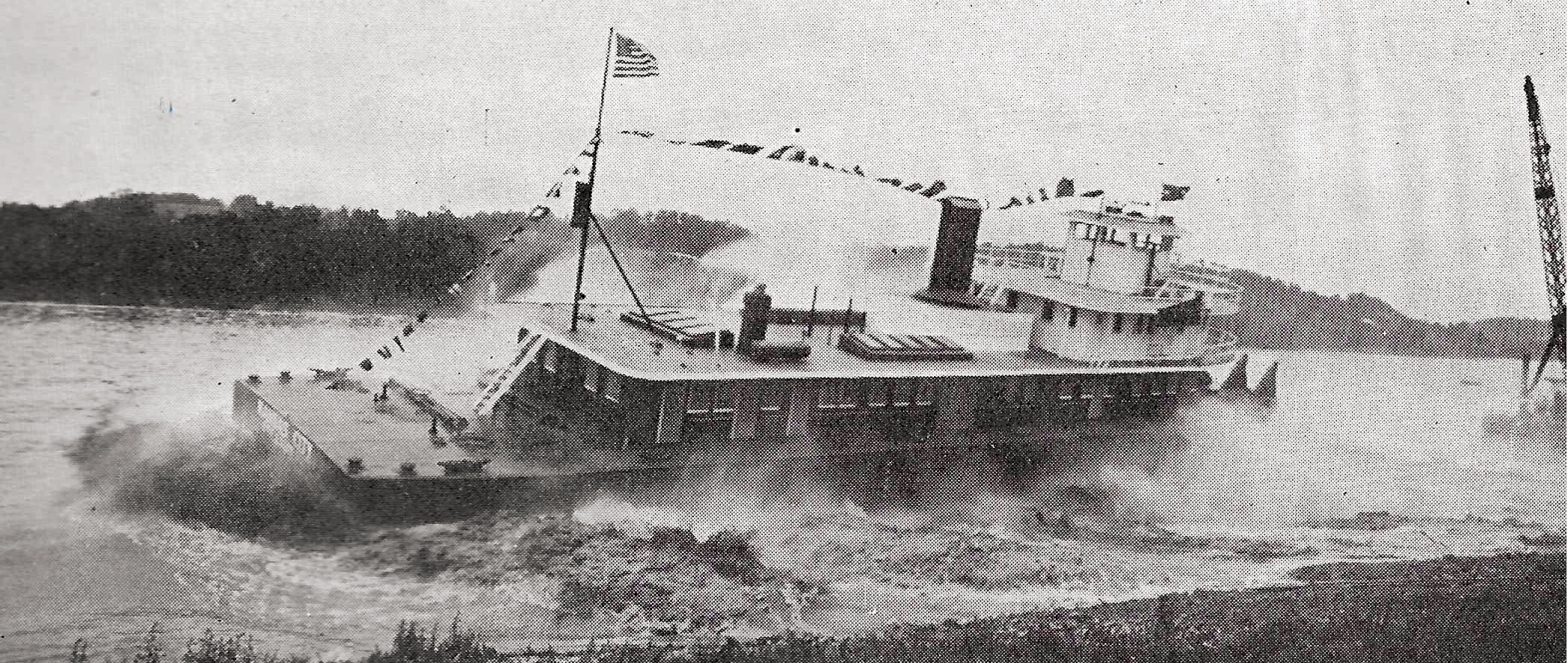
The Pittsburgh news column in the April 9, 1938, issue of The Waterways Journal reported that “excellent progress” was being made in the construction of the new boat for the Federal Barge Line (IWC) at MMC. The June 25, 1938, issue of the WJ carried a full story on the launch and christening of the new boat. It was named Kansas City and had been “successfully immersed June 17 into the Ohio River at Point Pleasant.”
Just before sliding down the ways, the vessel had been christened by Mrs. Harry H. Woodring, wife of the U.S. Secretary of War. Among others on the launch platform were Gen. and Mrs. T.Q. Ashburn; Lt. Col. J.D. Arthur Jr., Huntington District Engineer Department; J.S. Brodie, superintendent of maintenance for IWC; E.B. Oulliber, Canulette Ship Building; and Capt. Donald T. Wright, owner/publisher of The Waterways Journal, along with Mrs. Wright.
The new Kansas City was described as a steam, twin-screw towboat with a steel hull 160 feet by 40 feet. The engines had been built by Nordberg and were vertical triple expansion 10’s, 17’s, 27’s with 18-inch stroke rated at 1,000 hp. There was one Foster-Wheeler drum-type boiler providing 325 psi pressure at 100 degrees superheat. The upper cabin and pilothouse were of wood construction, and one tall stack rose behind the upper cabin.
Though early reports had stated that the new Kansas City was to be utilized on the Missouri River, it was used primarily on the Illinois River after being placed in service. Much was made of the fact that, at a time when trends were toward diesel power in new construction, IWC had built these new vessels with steam power. It is evidenced that the concern was looking to economize by using the machinery from the dismantled freight barges, as IWC would turn to diesel in future construction and repowering.
In 1948, the Kansas City was taken to the Arnold V. Walker Shipyard, Pascagoula, Miss., where it was extensively rebuilt. At this time, it was converted to diesel power with two GM 16-258S diesel engines totaling 3,000 hp. formerly on a Navy PC (Patrol Craft) vessel. Kort nozzles were also installed during the rebuild program.
In 1956, the Federal Barge Lines (formerly IWC, sold to private interests) sold the Tom Sawyer, sister vessel to the Kansas City. In 1957, the Kansas City was renamed Tom Sawyer, possibly due to the Sioux City and New Orleans vessel named Kansas City having been built in 1955. In 1958, the Tom Sawyer was repowered to 3,200 hp. with a pair of GM 16-278A engines and Falk 2.98:1 gears.
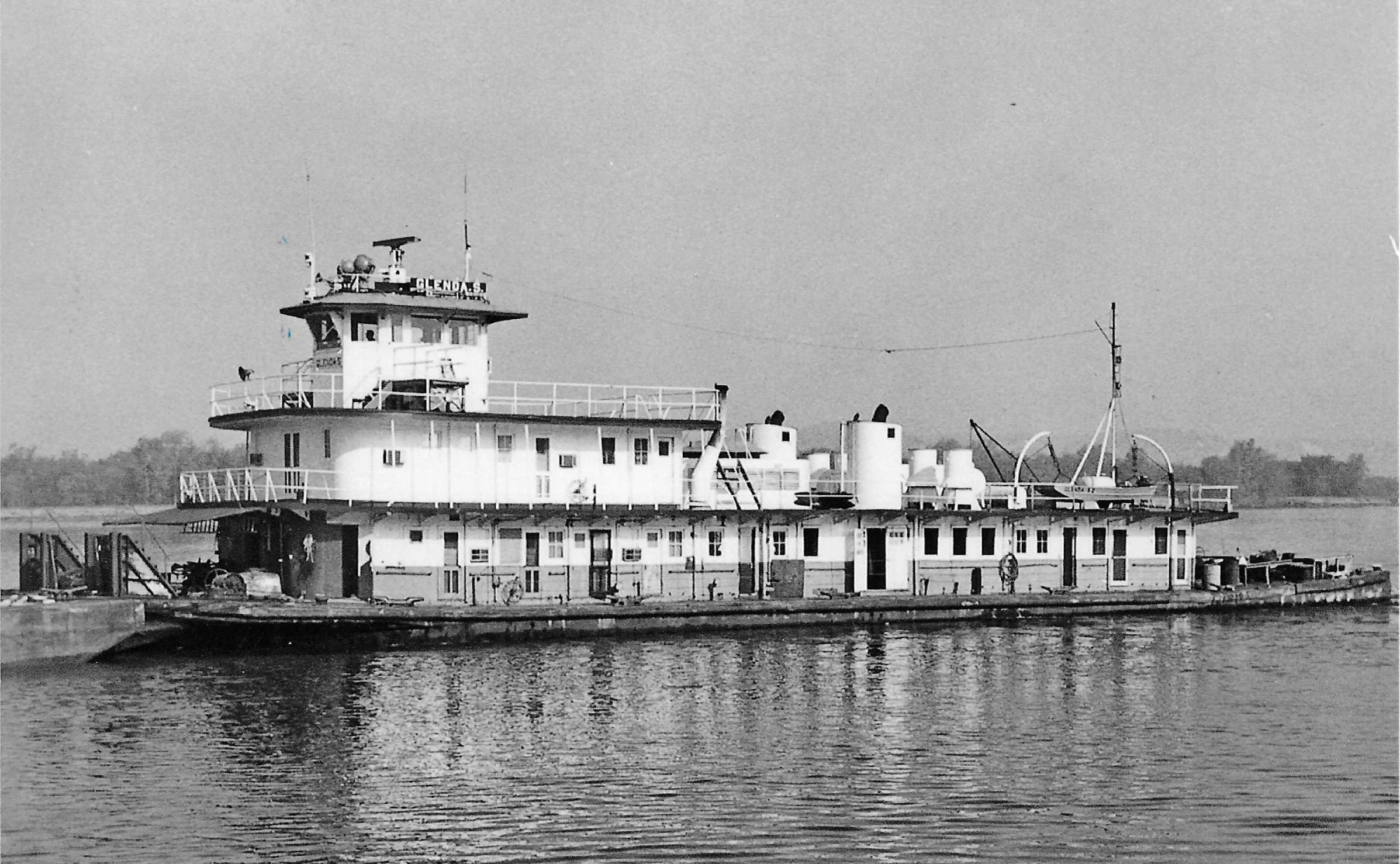
In 1962, the boat was sold to Capt. Donald L. Steele, St. Louis and renamed Glenda S. In 1963, it was sold to Cass Towing Company Inc., Cassville, Wis., and in June 1968 it was transferred to Pott Industries, St. Louis. In July 1969, it was sold to Wood River Towing Company, East Alton, Ill., and, later that year, it was sold to River Equipment Company, St. Louis. In 1970, it was again repowered, this time with GM 16-567 B engines of 3,200 hp.
In March 1971, the Glenda S was sold to Flowers Transportation, Greenville, Miss., and, in June 1973, it was sold to Leland Towing Corporation, also of Greenville. It was listed in the OFF THE RECORD section of the 1978 Inland River Record with the notation that it had been sold to Trotter Towing Corporation, Greenville to be converted into a landing boat.
Featured photo caption: Launch at MMC Point Pleasant on June 17, 1938, from the June 25, 1938, WJ. (Photo from the author’s collection)