

World War II Destroyer Prepares For Baton Rouge Homecoming
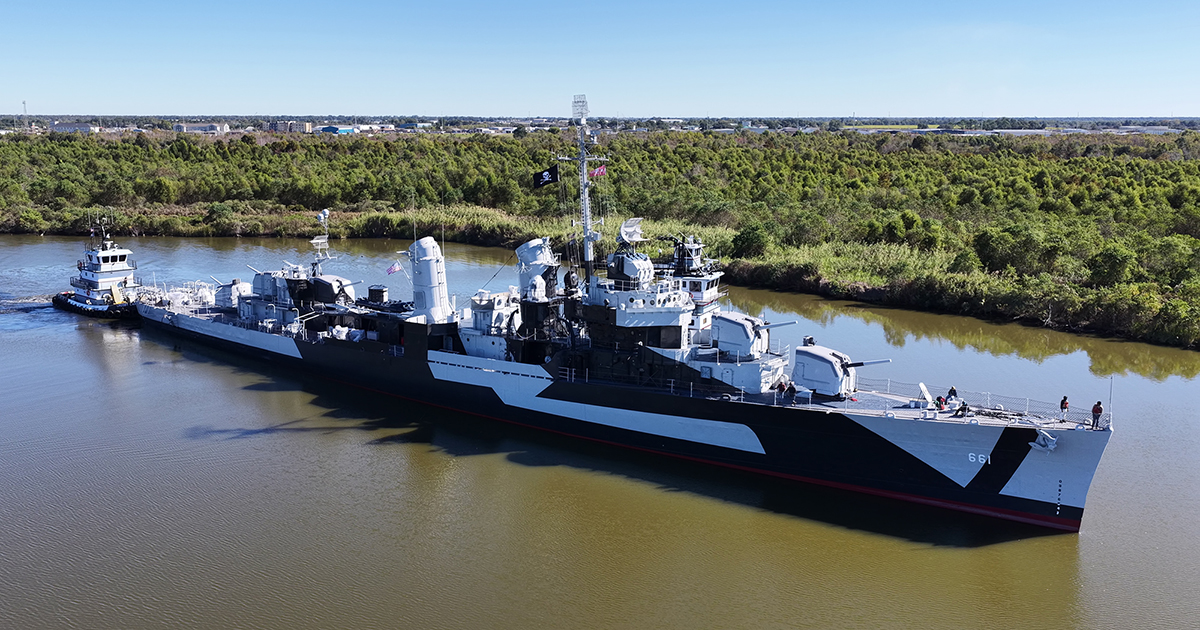
When the U.S.S. Kidd returns to Baton Rouge this spring, the World War II destroyer will have a new look, but most importantly, a longer lifespan and a brighter future.
Had the $15 million renovation not been completed in 2024 and 2025, the Kidd’s hull could have been compromised in as little as five to 10 years, said Tim NesSmith, ship superintendent and educational outreach coordinator. The Louisiana state legislature paid for much of the refurbishment, with help from private donors, helping to ensure that it remains on public display for many years to come.
Now, after spending two years away from its homeport and more than a year in drydock at Thoma-Sea Shipyard in Houma, La., “She is going to be as solid as she was when she was first built, and she’ll be around in another 40 to 60 years,” NesSmith said.
The city of Baton Rouge will host a homecoming celebration for the Kidd on May 23, the Saturday of Memorial Day weekend.
“Hopefully, she will be back by then and already open,” NesSmith said.
Rich History
Known as the “Pirate of the Pacific” because of the ship’s name being similar to that of the notorious pirate Capt. William Kidd, the U.S.S. Kidd (hull No. DD 661) is named after Rear Adm. Isaac Kidd, who was killed in action December 7, 1941, at the Battle of Pearl Harbor. At the request of his widow, the U.S. Navy authorized the Kidd as the only U.S. warship ever given permission to fly the skull and crossbones pirate flag. A pirate is also painted on the Kidd’s No. 1 smokestack.
While the connection to piracy is always interesting to children, adults are typically more interested in the Kidd’s history, including its participation in the invasions of the Gilbert and Marshall islands and in the Battle of Okinawa in World War II.
While the Navy decommissioned the Kidd in 1946, it was recommissioned in 1951, called into action as part of the Ready Reserve Fleet during the Korean War. The Kidd spent time patrolling the Korean coast and bombarding targets of opportunity. With the onset of the Cold War, the Kidd participated in anti-Soviet submarine patrols, took part in fleeting operations during the Berlin Crisis of 1961 and served as a training ship before being decommissioned a second time in 1962.
Out of 175 Fletcher-class destroyers built for World War II, the Kidd is one of only four still in existence and the only one restored back to its World War II configuration.
Over time, the other destroyers were modified with newer, heavier weaponry for the Cold War that required modifying the structure of the ships themselves. While obsolete weaponry was removed from the Kidd, it did not receive those major structural changes, meaning it took more minor modifications to restore it to its World War II appearance.
Return Timing Uncertain
The Kidd left Baton Rouge in April 2024, taking advantage of temporarily high water that made it possible to float it from its mooring cradle, which holds it securely off the muddy river bottom in lower water conditions.
Since leaving the Thoma-Sea drydock in November, the Kidd has been tied up at the shipyard, waiting for the perfect conditions to travel back up the Mississippi River to Baton Rouge. The location has served as the perfect place to wait for spring rains to swell the river so that it can return to the mooring cradle, which has been refurbished in its absence.
While the river is typically at its fullest in April or May, the exact timing of the Kidd’s return will depend on Mother Nature. The river must be at 29 to 32 feet on the Baton Rouge gauge to attempt the move.
“We’re hoping all that snow that’s there (farther north) right now stays and doesn’t melt yet, and then we’re hoping that when the spring rains come, we’re hoping all that comes down at once and then swells that river,” NesSmith said.
It will be easier to get the Kidd back in the cradle than it was to get it out, he said. Part of the reason why is that during the refurbishment, the Cold War era sonar dome that protruded from beneath the hull was removed. Another is that 4 feet was shaved off the rudder, which had been expanded in 1951, restoring it to its World War II configuration.
When the time is right, McKinney Salvage & Heavy Lift of Baton Rouge will place the Kidd back in its cradle.
“They have the most experience with this part of the river, and they’re a salvage company, so they know how to move stuff in and around tight places,” NesSmith said.
Extensive Refurbishment
Returning visitors to the Kidd will notice that, for the next five years, the Kidd will look a little different. That is because its new paint scheme displays 1944-era camouflage called measure 32/10D, often referred to as “dazzle camouflage.” The unique combination of grays and blues was meant to make it difficult for submarines firing torpedoes and aircraft dropping bombs to tell the Kidd’s size and direction of travel. When repainted in five years, the Kidd will return to its more familiar August 1945 paint scheme. That is important because it is the only remaining World War II destroyer renovated to the appearance of that period, NesSmith said.
“But for the next five years we wanted to give Baton Rouge and the world something different,” he said.
The battleship Texas had a workshop set up that turned out to be ideal for restoring the Kidd’s 40 mm guns, NesSmith said. Smaller equipment, including 20 mm guns, searchlights, torpedo directors and gun directors have been restored in-house while the Kidd was gone. Turner Industries came alongside the Kidd as a corporate partner in helping fund the refurbishment.
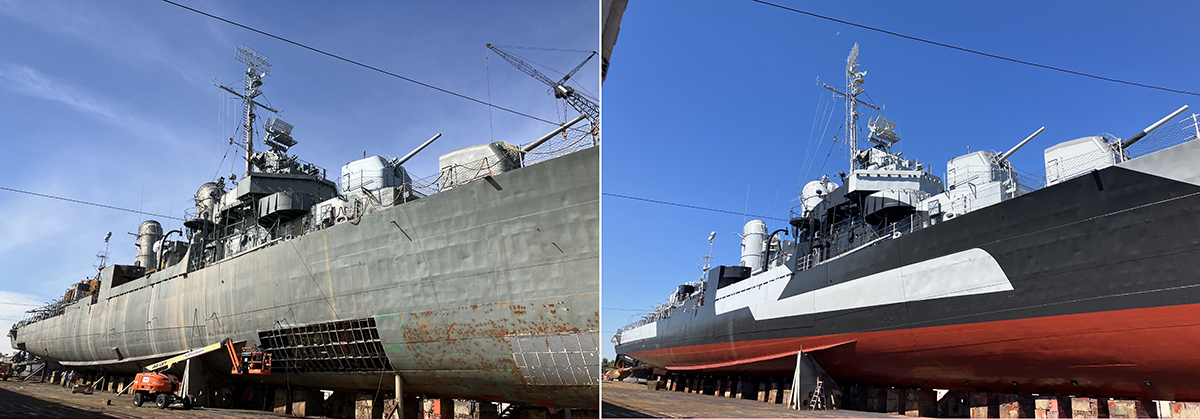
Much of the work completed at the shipyard is not visible to visitors but was still integral to the Kidd’s longevity, NesSmith said.
“When they first blasted her, they found a little more damage on the hull than they had expected,” he said.
Thoma-Sea cropped out the touchpoints where the Kidd’s hull touches the mooring cradle’s pads, adding in thicker panels and more support beams to reinforce those points.
Rivet lines and overlapping plates were welded to help ensure water-tight integrity.
Metal wastage where the Kidd’s aluminum superstructure met its steel decks was repaired. Additionally, metal wastage on decking in the pumproom on the Kidd’s refrigerated deck was addressed, with compartmentalization also restored so that, if the Kidd were to experience flooding, hatches could be sealed to prevent water intrusion elsewhere in the vessel.
Small hull openings through which water was drawn for steam engine condensers and pumped out from bilges have been plated over, eliminating a potential source of leaks.
While the 1941 air compressor was left in place, a new air compressor installed in an area out of public view helps to ensure continued reliability.
Expansion joints on the Kidd’s superstructure were also replaced. Materials connecting the sides of the joints are purposely designed out of thinner metal to allow them to flex as the ship moves through the water, but that thin metal rusts away quicker than other parts of the hull. While replaced in the 1990s, the Kidd needed another overhaul of the joints, which was much more easily completed in drydock conditions than it would have been in Baton Rouge, especially since it would have required closing part of the typical tour route.
Other renovations will help to keep the Kidd in good condition while moored or on future trips to drydock.
Docking collars around the Kidd’s mooring dolphins have a new lining that keeps the Kidd from moving no more than about an inch side to side while docked in Baton Rouge. A new plug system allows the sewage, freshwater and electrical lines to the boat to be easily connected and disconnected, as needed.
“We’re trying to think ahead so the next people who do this don’t have as huge of a headache as we did,” NesSmith said.
New Offerings
The renovations also have had another benefit. For the first time, the Kidd’s caretakers expect to be able to offer smaller, specialty tours in the coming months that will allow the public to visit areas never before on exhibit. That could include up-close looks at propulsion or weaponry, for example, and they may require guests to don hardhats and boots, NesSmith said.
The renovations have also led to the removal of radar equipment installed in the years after World War II, allowing ladders to be shifted to their proper 1945 configurations and restoring segregated stewards’ berthing appropriate to the era. Working with the Baton Rouge African American Museum, located two blocks away from the Kidd, tour guides are gaining a greater understanding of how segregation was carried out during the era and bringing some of those stories to life. Bunks and lockers will be added back to the space to show how those areas looked during the period.
What’s Next?
With the restoration of the ship complete and its future secured, the education program that teaches visitors about the Kidd is one of the next items to be updated and modernized.
A 40-year-old building that serves as a shoreside museum, with additional exhibits, is badly in need of renovation, NesSmith said, and caretakers want to take advantage of new technology to aid in telling the Kidd’s story.
Additionally, life rafts, depth charges and other smaller items still need to be restored.
To contribute or to learn more about the USS Kidd, visit usskidd.com.
Featured image caption: The U.S.S. Kidd in its new “dazzle camouflage” paint, the same colors in which the ship would have appeared in 1944 during World War II. The ship will retain the paint scheme for the next five years before returning to its typical August 1945 camouflage. (Photo courtesy of Hunter Svetanics/Johnson Marine)