
Still Working After 77 Years
H.G. “Chilli” Simpson of Charleston, Mo., a former Mizzou football player, began opening gas stations in southeast Missouri under the name Simpson Oil Company during the late 1920s and 1930s. By 1940, the business was strong enough that Simpson Towing Company was formed as a subsidiary. Nashville Bridge built a single screw, 800 hp. towboat for Simpson Towing in 1940, followed by a sister vessel in 1943. In 1945, St. Louis Ship delivered a 1,900 hp., twin screw boat to the growing company. In 1947, Simpson Towing added two boats of about 2,000 hp., both from F.B. Walker & Sons, Pascagoula, Miss. Then, in 1948, the company added two slightly larger boats from the same yard. The last five vessels in the Simpson fleet were leased or chartered from companies owned by the shipyards that built them.
F.B. Walker & Sons started in business in 1933 on property that had been a shipyard dating back to 1860. Walker began by building small tugs and towboats, turning out its first large towboat in 1945.
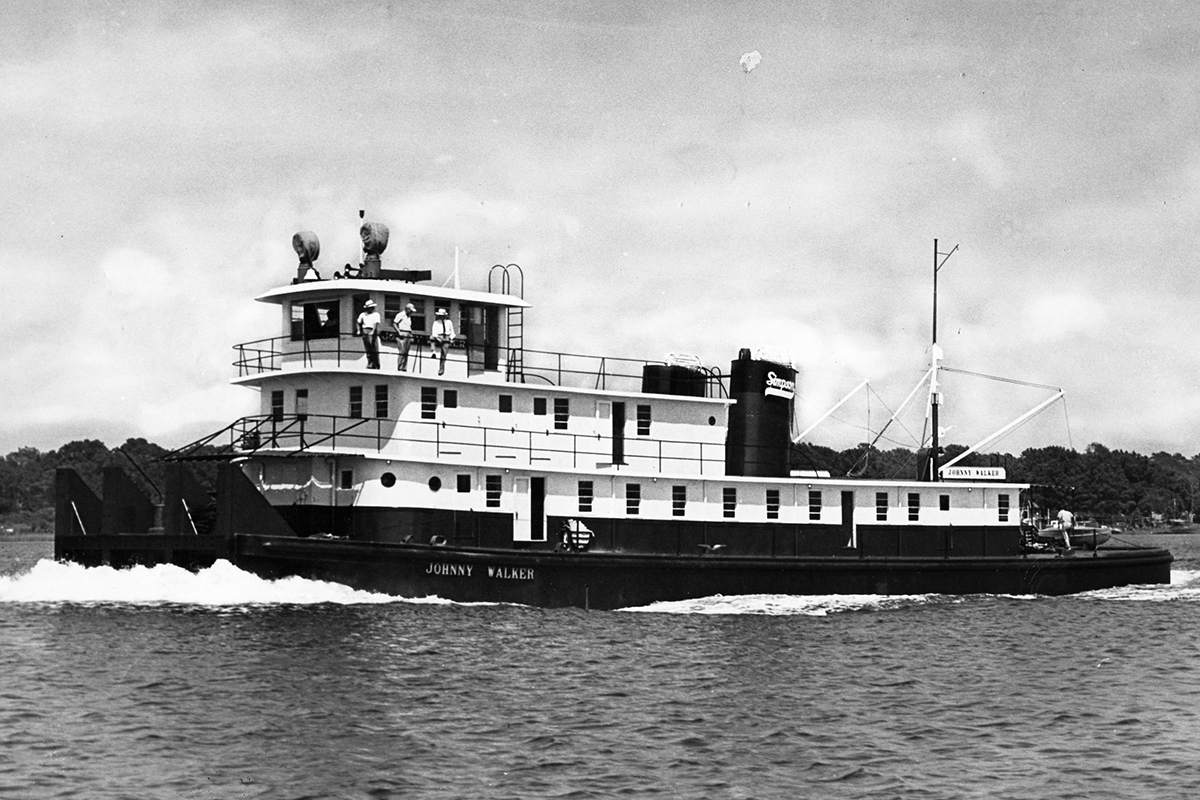
One of the towboats that the shipyard built and chartered to Simpson in 1948 was named Johnny Walker. It had a hull that was 120 feet long, 30 feet wide and 11.5 feet in depth. Due to the depth of hull, this series of Walker-built towboats was noted for having a higher freeboard than most river towboats. The Johnny Walker had somewhat of a boxy look, with the forward corners of the full main cabin gracefully curved and the forward edges of the upper cabin slightly rounded. The hull had a slight sheer and pronounced camber.
A large pilothouse topped the upper cabin. Two stacks, slightly angled aft, painted red and sporting the Simpson Oil logo, were behind the upper cabin. Glamour shots taken of the boat when new show no evidence of a radar.
The boat was powered by a pair of GM (Cleveland) 16-278A diesels producing 2,880 hp., coupled to Fawick Airflex clutches and Universal 2.5:1 reduction gears. The four-blade propellers were 84 inches in diameter with 72 inches of pitch, and the steering rudders extended 18 inches past the stern transom.
In late 1950 or early 1951, ownership of the Johnny Walker was transferred to Simpson Towing Company. A lead story in the May 19, 1951, issue of The Waterways Journal carried the headline “UNION BARGE LINE BUYS THE JOHNNY WALKER.” The piece reported, “H.G. Simpson met with Union Barge Line (UBL) operations manager Alvin D. Osbourne at the Hotel Mayfair in St. Louis and closed the sale” on May 14. Osbourne, whose first name actually was spelled “Alvan” and not “Alvin,” had a crew at the ready, and the Walker departed St. Louis the next afternoon with a UBL tow for New Orleans.
UBL was a subsidiary of Dravo Corporation and started in business with sternwheel steamboats in 1923. By May 1951, though, only one of those original vessels was still in service, while the other nine towboats in the fleet were diesel vessels built by the Dravo Contracting Company shipyard at Neville Island, Pa.
While talking recently with retired marine surveyor Bud Osbourne, son of Alvan Osbourne, and knowing he and his family had long been associated with UBL, I asked if he had any insight into why UBL purchased the Walker, since it had not been built by Dravo. Osbourne opined that it was probably due to UBL being busy and Dravo not having the capacity at the time to build UBL a boat. An arial photo of the yard taken in 1951 would lend credence to this, showing multiple vessels under construction.
J. Mack Gamble reported in the Upper Ohio news column of the June 2, 1951, issue of the WJ that the Walker was arriving at UBL’s Neville Island landing and would go to the Dravo’s shipyard, where it would be altered for general barge line service. Capt. Arlie Brotherton was aboard as master with Capt. Cecil Chaplin as pilot. In this same column, Gamble noted that the last UBL steam sternwheel towboat, the C.W. Talbot, had come out of layup to take a tow of gasoline to Boomer, W.Va., on the Kanawha River. The C.W. Talbot was sold and dismantled the following year.
UBL named the new acquisition Liberty, and since 1950 it had been assigned the radio call sign WB 6350. The boat must have performed well because UBL kept it for the next decade before selling it in 1962 to Badger Towing Company, Cassville, Wis. Badger renamed it Kay A. In 1970, the Kay A was transferred to Pott Industries (St. Louis Ship), St. Louis, and it was sold soon thereafter to Waxler Towing Company, Memphis, which renamed it Billy Waxler. The vessel carried that name for the next 43 years. In 1971, it was repowered with GM 16-567 engines that totaled 3,200 hp.
In March 2007, the owning entity became SCF Waxler Barge Line LLC. C&C Marine and Repair in Belle Chasse, La., extensively rebuilt the Billy Waxler in 2009. A third cabin was added with a new pilothouse above that. In 2012, it was transferred to SCF Liquids, St. Louis, and in 2013, it was renamed SCF Energy. In April 2016, the boat was sold to Kirby Inland Marine LP of Houston. It was sold the following month to Excell Marine Corporation of Cincinnati, which changed the name to Energy.