
The Weber W. Sebald Was Among The Last Large Steam Sternwheel Towboats
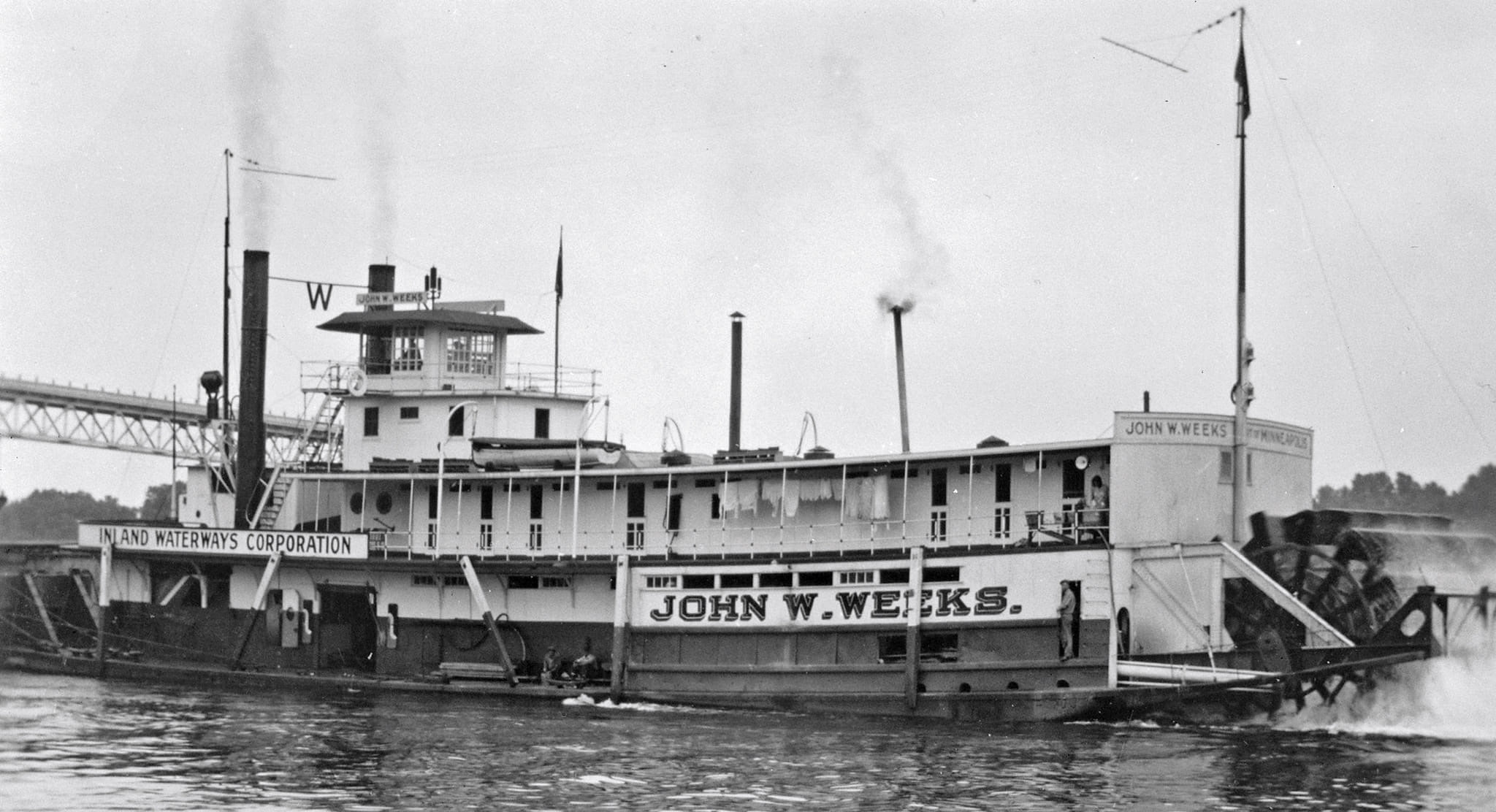
Four steam, sternwheel towboats were built by Dubuque Boat & Boiler Company for the Upper Mississippi Barge Line, and in turn leased to the Inland Waterways Corporation (IWC). The first three of these boats were built in 1927, with the initial boat being the S.S. Thorpe, named for Samuel S. Thorpe, a Minneapolis Realtor, founder of the National Association of Realtors and first chairman of the Upper Mississippi Barge Line Company (UMBLC). The second of the four boats to come out was the C.C. Webber, named for Charles C. Webber, a vice president of Deere & Company and last surviving grandson of John Deere. Webber had long been an advocate of an improved Upper Mississippi River channel and served as president of the UMBLC. The third boat was the General Ashburn, named for the head of the IWC, and the fourth, which came out in 1928, was the John W. Weeks, named after a recently deceased former Secretary of War.
All four of these boats had steel hulls 130 feet by 35 feet by 5 feet with Nordberg condensing engines, 15’s, 30’s – 6.5-foot stroke rated at 600 hp. The water tube boilers were fired by oil. The IWC operated these boats on the Upper Miss, Missouri and Illinois rivers. A small cabin was eventually placed under the pilothouse to give the boats more eye level.
The S.S. Thorpe was sold to the American Rolling Mill Company (Armco Steel) in 1940 and renamed Geo. M. Verity. The company would also purchase the John W. Weeks in 1948. The General Ashburn was sold to the Hatfield-Campbells Creek Coal Company in 1941, which would later purchase the C.C. Webber in 1947. Thus, all four sister boats came to the Ohio River and worked in close proximity to each other for the remainder of their days.
About a month after Armco Steel purchased the John W. Weeks, it was renamed Weber W. Sebald after the company president. The boats in the steel company fleet would tow coal loaded at a terminal in Huntington, W.Va., to Cincinnati, where it was offloaded for shipment to an Armco facility at Middletown, Ohio. In addition to the Geo. M. Verity previously mentioned, Armco also had the Charles R. Hook, built by Ward at Charleston, W.Va. in 1922 as the Destrehan for Pan American Petroleum.
On April 24, 1956, a staged race was held at Huntington, W.Va., between the Weber W. Sebald and the J.T. Hatfield, which was the former General Ashburn, a sister vessel to the Sebald. The NBC TV Today show, starring Dave Garroway, was broadcast live from aboard the Sebald, with both Garroway and the chimpanzee J. Fred Muggs on hand. This race was replicated later with the Ellen Hatfield, the former C.C. Webber, pitted against the Sebald. Another contest between these boats was later held at Charleston, W.Va., on the Kanawha River.
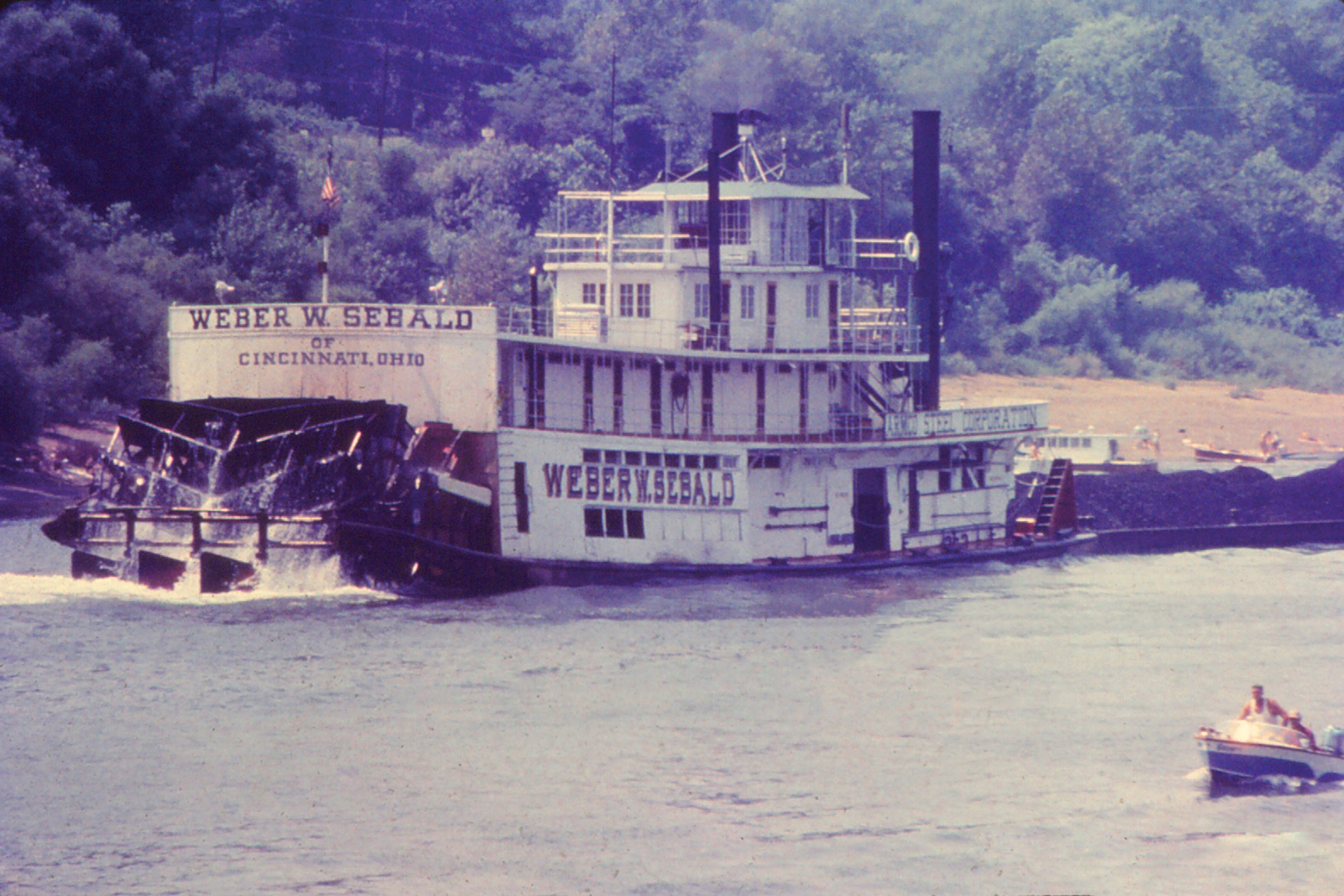
The Sebald and the other Armco boats were fitted with a sternwheel of a unique design during this time period. It was described as a helical or herringbone style, in which the buckets were angled toward the center in a “V” shape, rather than the usual straight across. Some have said that this design increased the thrust of the wheel but did not perform well while backing.
At some point, a traditional style sternwheel was placed back on the Weber W. Sebald. By 1960, steamboats were being phased out in favor of diesel craft. Armco ran the Geo. M. Verity and the Sebald until that year, making them among the last of the larger steam sternwheel towboats in operation. The Verity was given, or “sold” for one dollar, to become a museum at Keokuk, Iowa, where it remains today. In a similar fashion, the Sebald went to Ashland, Ky., to become the headboat of a boat club at the city front.
The boilers and engines were removed and scrapped. After a decade of lying at Ashland, the powers that be decided that the hull was badly deteriorated and replaced the boat with a barge that had a structure on it. The Sebald whistle and a nameboard were donated to the Ohio River Museum at Marietta, Ohio, while the bell was first placed in front of the Ashland city building and later moved to the revamped park at the city front.
The boat itself was sold to Mountain State Construction, St. Albans, W.Va. It sank at the company’s landing the night of November 2, 1970, and was never raised. Vandals later set the cabin and pilothouse on fire, and the stacks eventually fell. Through the efforts of the late Charles T. Jones of Amherst Madison, the sternwheel shaft was removed and presented to the Point Pleasant (W.Va.) River Museum.
The museum, now known as the Point Pleasant River Museum and Lakin Ray Cook Learning Center, is currently in the process of restoring the shaft for display.
Featured photo caption: The John W. Weeks in service for the Inland Waterways Corporation. (Photo from the author’s collection)